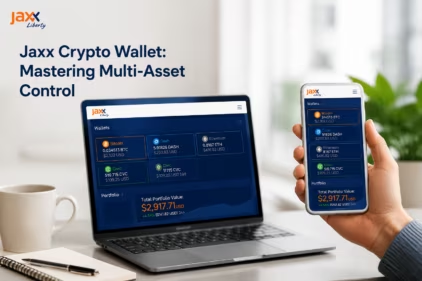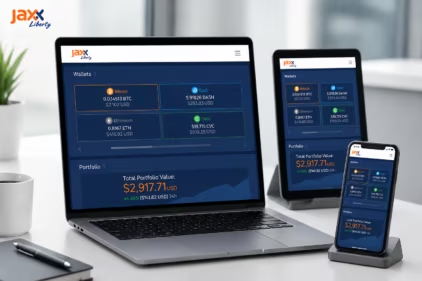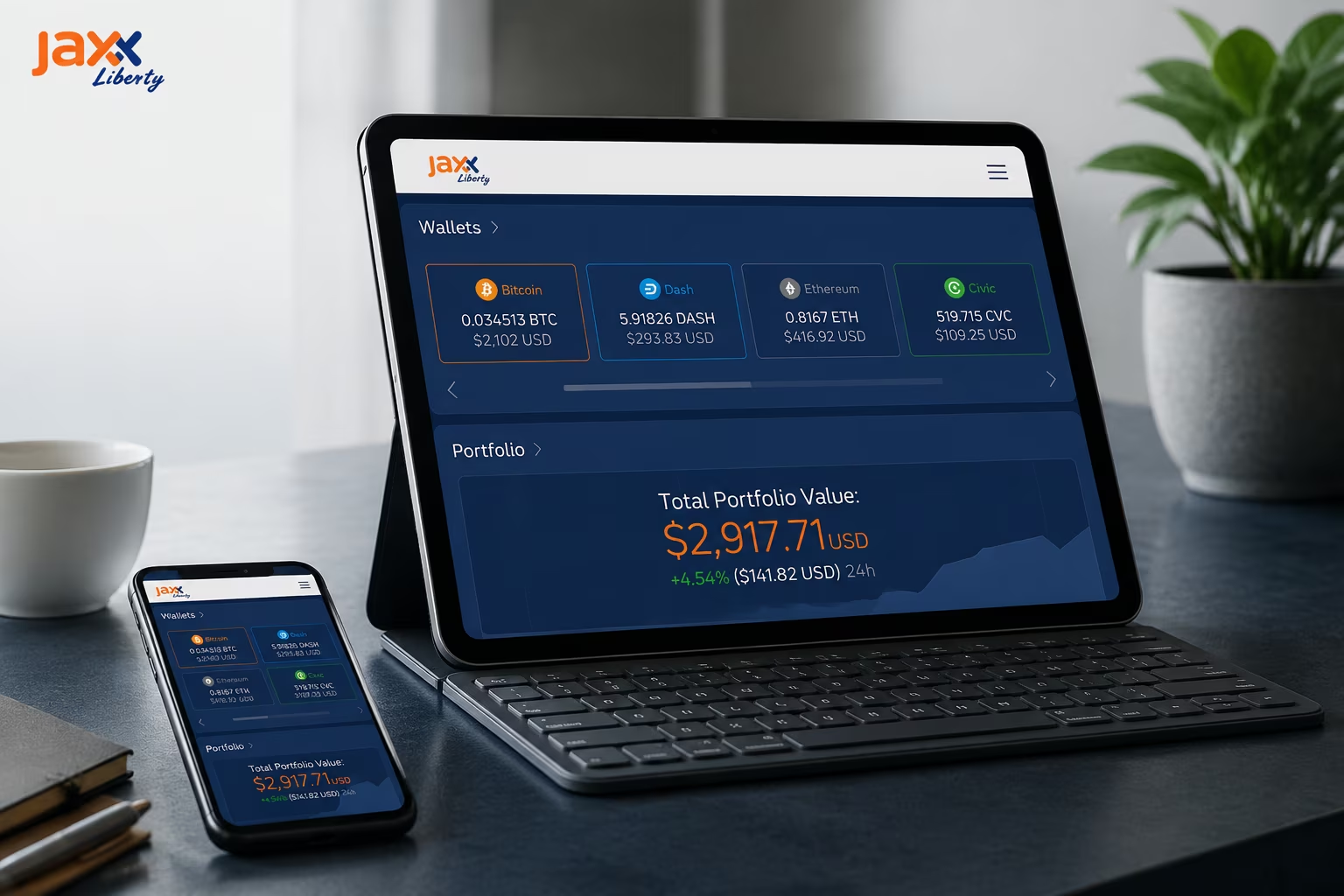
- Ownership Model: Non-custodial local storage
- Standard Protocol: BIP39 mnemonic seed phrase
- Control Level: Absolute user-side finality
- Security Risk: 100% loss on credential leak
Jaxx liberty private keys are the unique cryptographic codes that grant you absolute ownership and transaction authority over your digital assets. These keys function as the definitive proof of wallet control, ensuring that only the holder can authorize transfers or manage funds. Because Jaxx Liberty is non-custodial, your keys remain stored locally on your device rather than on our servers.
- How seed phrases generate wallet access
- Why key access equals control of the wallet
- The biggest mistakes that expose Jaxx Liberty wallet keys
- Expert view on self-custody discipline
- US rules that matter when self-custody wallets interact with exchanges
- Why missing funds can be a derivation path issue instead of a loss
- The financial cost of poor private key protection
- Conclusion
How seed phrases generate wallet access
Those 12 words generated when you first set up your Jaxx Liberty Wallet aren’t a password — they are your entire wallet, mathematically compressed into human-readable form. Not a hint. Not a backup code. A precise, cryptographic reconstruction of every private key and address your wallet will ever produce. Lose them, and you lose everything. Protect them, and you hold complete, permanent control over your funds — no server required, no account needed, no platform standing between you and your assets.
The mechanics underneath this are ruthlessly elegant. Your 12-word phrase gets converted into a 512-bit seed through PBKDF2 with HMAC-SHA512 — 2048 iterations, salted with the fixed string «mnemonic.» That seed then runs through BIP32’s HMAC-SHA512 function using «Bitcoin seed» as the key, producing a master private key and a chain code. From that single master key, an unlimited hierarchy of child private keys branches outward — one path for Bitcoin, another for Ethereum, another for Litecoin, and so on across every asset Jaxx Liberty supports. As the D’CENT Wallet Blog makes clear, this BIP39 derivation chain — mnemonic to seed via PBKDF2, through to final private keys and addresses — is what makes consistent, cross-platform recovery possible in the first place.
Here’s the part that matters most: the derivation is fully deterministic. The same 12 words, entered anywhere, always produce the same keys and addresses in the same order. Every time. Without exception. That’s what makes BIP39 wallet access genuinely platform-independent — plug your phrase into any BIP39/BIP32-compatible non-custodial wallet and you recover the exact same accounts with the exact same balances. Jaxx Liberty is built on this architecture by design. No keys stored on any server. No phrase held by anyone but you. No mechanism to restore access from the outside. The words you wrote down at setup? That’s the only recovery path that exists. For a practical walkthrough of how this works inside the app, see the full BIP39 wallet recovery steps.
Self-custody is a trade. Full control in exchange for full responsibility. No centralized reset button. No support ticket that magically restores access. No fallback if your phrase walks out the door. And make no mistake — anyone who gets their hands on your 12 words holds exactly the same power over your assets that you do. That’s not a flaw in the system. That’s the system working exactly as intended. So treat your recovery phrase like the physical asset it is: written on paper, stored offline, never photographed, never typed into anything connected to a cloud service, never shared with anyone under any circumstances. Phishing attacks are getting sharper. Wallet exploits are getting more creative. The security of those 12 words is the security of your entire portfolio — full stop.
Private key, seed phrase, and wallet access compared
Understanding the hierarchy of access is critical for maintaining your security in a non-custodial environment. In Jaxx Liberty, we ensure you have full control over your assets, but this requires you to distinguish between your master backup and local authentication methods. Proper Jaxx Liberty seed phrase protection is the foundation of your digital sovereignty.
| Access Layer | Format | Recovery Scope | Sensitivity Level |
|---|---|---|---|
| Seed Phrase (Mnemonic) | 12-24 words (BIP39) | Entire wallet and all accounts | Highest (Full compromise risk) |
| Private Key | 256-bit string | Single specific address only | Medium (Single asset risk) |
| Wallet Password | User-defined | None (Local app access only) | Low (No direct fund access) |
| Device Access | PIN / Biometrics | None (Physical interaction) | Lowest (Replaceable) |
Why key access equals control of the wallet
In Jaxx Liberty, whoever holds the private key holds total, unconditional control over every asset tied to that address — no exceptions, no appeals, and zero chance of reversing a transaction made by someone else using your credentials. That is the bedrock of key-based ownership. No username. No password reset. No support ticket that saves you. The blockchain sees only the key — not your face, not your device, not your intentions.
Your seed phrase and the private keys derived from it are the single point of authority over your funds. One person. One phrase. Total access. If someone else gets that recovery phrase — accidentally, through a phishing link, or because you trusted the wrong person — they walk straight into your wallet. They can import it into any compatible app, see every balance across every supported asset, and drain it completely. Fast. The wallet has no way to tell you apart from someone who presents the correct credentials. Key control is wallet control. Full stop.
As experts at Ledger Academy emphasize, cutting off private keys from internet-connected environments ranks among the most decisive steps in protecting crypto holdings. Jaxx Liberty keeps your private keys stored locally on your device, never pushing them to external servers. Real ownership — not the performative kind. But that architecture comes with a hard trade-off: the entire weight of security sits on your shoulders. A seed phrase screenshot synced to Google Photos, a quick snap sent through Telegram, a note buried in an unsecured app — any of these quietly hands someone else a door key to everything you hold.
Jaxx Liberty was built around the conviction that self-custody should mean something. Your keys never leave your device through our infrastructure. That is the promise. The flip side is equally direct: if credentials are lost or compromised, there is no recovery mechanism on our end. None. So treat your seed phrase with the gravity it deserves. Write it on paper. Lock that paper somewhere physically secure. Never type it into any website, app, or form you did not initiate yourself. Your control over crypto starts and ends with your control over that private key — and not a single thing sits between those two facts.
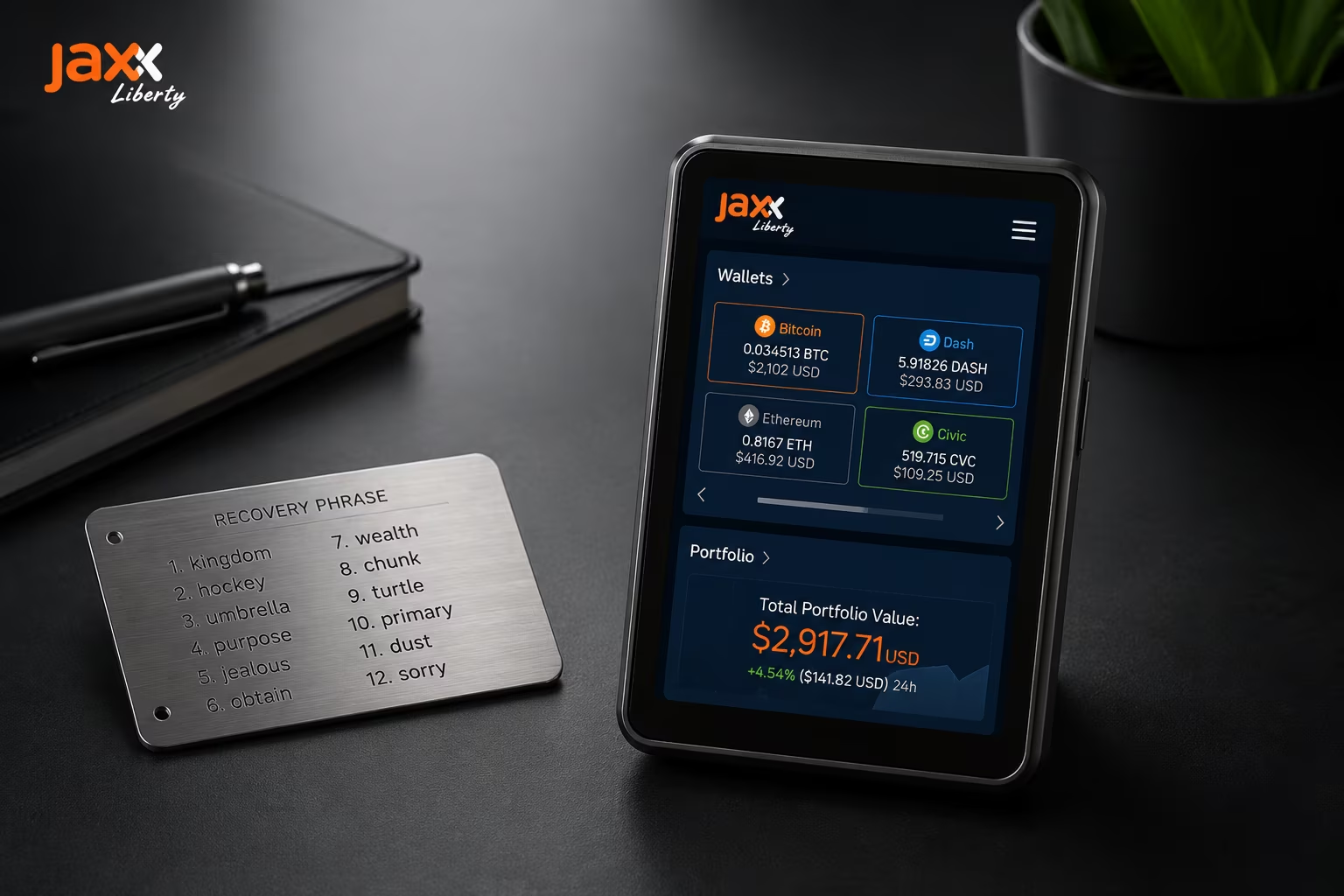
The biggest mistakes that expose Jaxx Liberty wallet keys
Every mistake that exposes a Jaxx Liberty private key traces back to one brutal error in judgment: treating your seed phrase like a regular piece of text you can screenshot, paste, or sync without consequence. Private keys and seed phrases are the only proof that those assets belong to you. Whoever gets them gets everything — instantly, irreversibly, with zero recourse. No confirmation prompt. No undo button. Knowing exactly where exposure happens is how you stop it before it starts.
Screenshots feel harmless. They’re not. The moment you capture your seed phrase or private key on a smartphone or laptop, your device’s photo library picks it up and — without asking — ships it to cloud storage. Google Photos, iCloud, whatever sync service runs quietly in the background. Your key data can leave your device within seconds, and you’ll never see a notification about it. The same trap exists in notes apps. Apple Notes, Google Keep, Notion — they all sync to remote servers by default. Type your seed phrase into any of them and you’ve handed it to a third-party infrastructure you don’t control. The Jaxx Liberty private key guide makes this point without softening it: never digitize your private key or seed phrase in any form that touches the internet or an external server. Full stop.
Phishing is the other side of the exposure problem — and it’s ruthlessly effective. Fake support pages, counterfeit wallet interfaces, social engineering messages that ask you to «verify» or «restore» your wallet. They all want the same thing: your seed phrase typed into a form you think is legitimate. It never is. No real wallet service will ever ask for your private key or recovery phrase. Ever. Malware compounds the risk further — keyloggers and clipboard hijackers work silently, capturing key data the instant you type or paste it on a compromised device. Ledger Academy’s security checklist puts it plainly: hot-device exposure and careless storage habits are the primary vectors for key leakage. That applies to every self-custody wallet environment, Jaxx Liberty included.
Here’s the architecture that matters: Jaxx Liberty stores private keys locally on your device. That local control is the security model. The whole thing. Once key data moves off your device — through a sync, a screenshot, a cloud note, a phishing form — the model collapses entirely. Write your seed phrase on paper. Store it somewhere physically secure. Never enter it on a device you don’t fully trust and fully control. These aren’t suggestions for cautious people. They’re the minimum operational requirements for anyone managing a non-custodial wallet where no centralized recovery exists and no one is coming to help if something goes wrong.
Threats to private key security and safer alternatives
Protecting your private keys is the foundation of self-custody. Because Jaxx Liberty is a non-custodial wallet, we store your keys locally on your device, meaning you have total control—and total responsibility. Understanding how to mitigate Jaxx Liberty seed phrase protection risks is essential to preventing unauthorized access to your assets.
| Threat Vector | Likely Consequence | Safer Alternative |
|---|---|---|
| Screenshots & Photos | Malware screen capture | Physical paper backup stored in a secure safe |
| Cloud Sync Services | Centralized credential leak | Encrypted local storage or offline cold storage |
| Malware & Keyloggers | Key interception during input | Hardware wallets (Ledger/Trezor) or airgapped devices |
| Clipboard Hijackers | Theft during copy-paste | Manual entry or dedicated signing devices |
| Weak RNG Generation | 200,000+ addresses compromised | Open-source audited wallets with unique nonces |
Expert view on self-custody discipline
Your private key is not a password you can reset — it is the only proof of ownership that exists, and losing control of it means losing everything attached to it. Hold your own keys, and you hold total control over your assets. That control carries total responsibility. Jaxx Liberty is built around this reality from day one: private keys are generated and stored locally on your device, never sent to any server, never visible to us. No third party can freeze your funds or bail you out — and if your key material gets exposed, the fallout lands squarely on you.
Security experts converge on two non-negotiable disciplines: offline protection and device hygiene. Your private keys and seed phrase must never exist in any digital format connected to the internet. No screenshots. No cloud backups. No email drafts. No note apps syncing quietly to someone else’s server. Write your recovery phrase on paper and lock it somewhere physically secure. If you access Jaxx Liberty Wallet across multiple devices, treat every single one as a potential attack surface — because it is. Keep your OS and apps current, skip software from unverified sources, and never enter your seed phrase on a device you do not fully own and trust. As the team at Ledger Academy puts it plainly, strict operational security around private keys is the foundation of any serious self-custody setup — and that standard holds regardless of which non-custodial wallet you use.
Understanding what «access» actually means in a non-custodial system is not optional knowledge. Anyone who gets your private key or seed phrase gains complete, irreversible control over every asset tied to that key. No dispute process. No support ticket. No recovery mechanism that overrides this. Jaxx Liberty covers multiple cryptocurrencies — Bitcoin, Ethereum, Litecoin, and more — all derived from a single seed phrase. Convenient? Absolutely. But that also means one exposure point can wipe your entire portfolio across every supported asset simultaneously. This is precisely why Jaxx Liberty keeps all key material local, and why the answer to «can you recover my seed phrase?» is a direct, honest no.
The mindset shift that separates users who stay secure from those who do not comes down to one thing: treat your key material the way you would treat a physical deed, a vault combination, or a bearer instrument. Use a clean, dedicated device when you can. Confirm you are running the legitimate Jaxx Liberty application. Never share your seed phrase with anyone — including anyone claiming to be support. These are not edge-case precautions for paranoid power users. With phishing attacks and wallet exploits growing sharper every year, these habits are the baseline. Private key confidentiality is not a feature you configure once and forget. It is a discipline you build, reinforce, and never stop practicing.
Take full control of your digital assets by managing your private keys and recovery phrases within a secure, non-custodial environment.
US rules that matter when self-custody wallets interact with exchanges
The moment your self-custody wallet touches a regulated exchange, US compliance rules activate — and knowing exactly where that boundary falls is non-negotiable for anyone serious about managing digital assets in 2026. FinCEN’s Travel Rule forces Virtual Asset Service Providers (VASPs) to collect and transmit specific data on any convertible virtual currency transfer above $3,000. We’re talking originator name, wallet address, account identifier, transfer amount, date — plus the beneficiary’s name, wallet address, and receiving institution. Custodial platforms and exchanges carry this burden. Self-custody wallets operating in pure peer-to-peer environments do not.
That distinction has real teeth when it comes to wallet ownership proof and how you control digital asset access. Move funds from Jaxx Liberty to a centralized exchange, and that exchange — acting as a VASP — is legally obligated to collect originator data from you as their customer. They retain it even when no counterparty VASP exists on the other end. Jaxx Liberty itself? Zero reporting obligations. The wallet does not custody your funds, does not hold your private keys, and does not function as a financial intermediary. Your keys live on your device. Full stop. That architecture is precisely what keeps Jaxx Liberty outside the VASP definition under current US regulatory frameworks.
As Sumsub confirms, the $3,000 Travel Rule threshold targets custodial wallets and exchanges specifically — self-hosted wallets used without VASP involvement face no data collection requirements whatsoever. Peer-to-peer transfers between two self-custody wallets sit entirely outside the compliance perimeter. The second you route a transfer through an exchange or custodial service, though, that platform’s US crypto compliance obligations snap into effect. The exchange documents the transaction on their side. Doesn’t matter whether your wallet is hosted or self-custodied — their obligation triggers regardless.
So what does practical risk management actually look like here? Be ready to verify your identity and provide wallet information whenever you move funds from Jaxx Liberty to any regulated exchange above the threshold. Keep transaction records clean and organized. Know which platforms in your jurisdiction operate as VASPs. And never assume that holding a self-custody wallet exempts every transaction from scrutiny — it exempts your wallet from being the reporting entity, not the exchange sitting on the other side of the transfer. Jaxx Liberty’s non-custodial design puts full control in your hands and keeps your private keys local, but US crypto compliance responsibilities shift to the VASP the instant your assets enter their system. That boundary isn’t a technicality. It’s the foundation of responsible digital asset access in today’s regulatory landscape.
Why missing funds can be a derivation path issue instead of a loss
Zero balance after restoring your seed phrase almost never means your funds are gone — it means the wallet is looking at the wrong derivation path, scanning addresses that were never funded in the first place. HD wallets generate addresses through a structured mathematical formula: m/44’/0’/0’/0 for Bitcoin, m/44’/60’/0’/0 for Ethereum, and so on. Restore the same phrase in a different app, and that app may default to an entirely different path standard — producing a completely alien set of addresses. Identical phrase. Completely different location.
This is where most people panic unnecessarily. Your seed phrase is correct. Your private keys are mathematically intact. The software is just looking in the wrong room. Bitcoin alone has three competing path standards in active use: legacy (m/44′), wrapped SegWit (m/49′), and native SegWit (m/84′). Each one generates a distinct address set. If your original wallet lived on m/44′ and your current wallet defaults to m/84′, the balance reads zero — not because anything moved, but because the wallet is scanning addresses that have never seen a single satoshi. Jaxx Liberty follows defined derivation standards for each supported asset, which is why restoring within the same application reliably surfaces the correct address set and the correct balance every time.
Fixing a derivation path mismatch requires two things: knowing which path your original wallet used, and getting your current tool to match it. Some wallets expose this under advanced settings. Others force you to import the seed into a path-aware recovery interface — which is more work, but entirely doable. The complexity compounds fast when you’re managing Bitcoin, Ethereum, Litecoin, and other assets at once, because each coin may follow its own BIP standard. This is exactly why understanding how private keys map to addresses matters just as much as keeping the phrase safe. For a closer look at how key-level access works across wallets and coins, the guide on secure private key recovery breaks down the relationship between keys, addresses, and real asset control in a non-custodial setup.
Before you conclude anything is lost, do this: document the wallet application you originally used, identify which coin types were stored, and check whether any custom path settings were configured at setup. Jaxx Liberty stores private keys locally on your device and derives addresses deterministically from your seed — same phrase, same path, same keys. Every single time. If you’re recovering across platforms or after a device change, matching the derivation path is not a detail. It’s the whole game. Funds are not lost until every relevant path has been checked and ruled out.
Safe recovery practices for regaining wallet access
Regaining access to your assets requires a disciplined approach to ensure your 12-word backup phrase remains confidential. Since Jaxx Liberty is a non-custodial wallet, we do not store your keys on our servers; they exist only on your device. Follow these steps to restore your wallet safely on a new or existing device:
- Verify your environment by ensuring the device you are using is free from malware, keyloggers, or screen-recording software. Always perform recovery on a trusted, private network rather than public Wi-Fi.
- Download the official Jaxx Liberty Wallet application only from our verified website or official app stores to avoid phishing versions designed to steal your seed phrase.
- Select the «Restore Wallet» option upon launching the application. This will prompt you to enter your unique 12-word backup recovery phrase in the correct sequence.
- Input your recovery phrase manually using the on-screen interface. Never copy-paste your phrase from a digital file or cloud storage, as this exposes it to clipboard vulnerabilities.
- Set a strong Security PIN immediately after the restoration is complete. This adds a local layer of protection for transactions and viewing sensitive data on that specific device.
- Check your asset balance and portfolio sync. If you need to manage specific coins individually, you can also look into a Jaxx Liberty private key import for advanced recovery of specific blockchain addresses.
- Secure your physical backup by returning your written recovery phrase to a safe, offline location. Never take a photo of it or store it in an email.
The financial cost of poor private key protection
One exposed private key is all it takes — every asset in that wallet, gone forever, with zero recourse. In a non-custodial setup like Jaxx Liberty, private key management isn’t some background technical footnote. It’s the whole game. Your keys live locally on your device, never touching any server, which means the security of those keys belongs entirely to you. Full control is the reward. Full responsibility is the price.
According to Chainalysis, credential and wallet security failures consistently rank among the top causes of crypto theft — billions lost every year, most of it tracing back to a single, painfully avoidable failure point: a key that got exposed. And this isn’t just a problem for exchanges or institutions. Regular users storing private keys in screenshots, cloud notes, email drafts, or plain text files are carrying the exact same risk. The moment an unauthorized party sees that key, they can import it into any compatible wallet and drain everything in seconds. No reversal. No dispute. No way back.
Wallet backup safety isn’t a checkbox you tick once and forget. It’s a habit. The prevention cost is laughably low: write your seed phrase on paper, lock it somewhere physically secure, and never — under any circumstances — type it into an online form or hand it to a third party. The cost of getting it wrong? Total. Every asset tied to that key, across every supported network, becomes fair game for whoever holds it. That’s precisely why Jaxx Liberty is built around local key storage, and why we’re blunt about what that means for you. No password reset exists. No account recovery without your seed phrase. We cannot restore your access. Nobody can.
The users who hold onto their assets long-term aren’t luckier than those who lose everything — they’re more disciplined. They treat private key management like a financial practice, not a one-time technical step. Before you park any real value in a self-custody wallet, do three things: verify your backup, confirm your seed phrase actually works, and audit every location where your key material currently exists. Asset ownership verification begins with a simple, uncomfortable question — if your device died right now, could you recover everything? The upfront effort is minimal. The alternative is a loss that no one, including us, can fix.
Conclusion
In self-custody crypto, key access equals control — full stop — and that single truth defines everything about how Jaxx Liberty operates. Your private keys live locally on your device. Not on a server. Not in some corporate database. That means you hold genuine ownership of your assets, around the clock, with zero intermediaries in a position to freeze your funds, revoke your access, or make decisions about your money on your behalf. The power is yours. So is the responsibility.
The single most critical move you can make for long-term wallet security? Guard your recovery phrase like it’s the deed to your house — because functionally, it is. That 12-word seed phrase is the only mechanism capable of restoring your wallet on a new device. Write it on paper. Store that paper somewhere physically secure. And never — not once — save it as a screenshot, a notes-app entry, or anything touching a cloud service. If another person gets hold of your recovery phrase, they gain complete, immediate control over every asset in your wallet across all supported cryptocurrencies, including Bitcoin, Ethereum, and Litecoin. No appeal process. No reversal.
Secure key management isn’t a box you check once and forget. It’s a practice. Use clean, trusted, malware-free devices every time you access Jaxx Liberty. Never enter your seed phrase on a public network or a shared machine — ever. Keep a second physical backup of your recovery phrase in a separate secure location. Why? Because a single point of failure — one house fire, one theft, one misplaced notebook — should never mean permanent loss of access to real value. These aren’t paranoid edge-case precautions. They’re the baseline.
Jaxx Liberty is built on a straightforward conviction: users deserve direct, unmediated control over their crypto. No password resets. No centralized account recovery. No custodial fallbacks — because every one of those systems demands that you trust a third party with your assets. Instead, you get the tools and the architecture to be your own authority. Understanding how private keys work, why your seed phrase matters, and how to store it without compromise isn’t optional knowledge. It’s the foundation of responsible self-custody, full stop.
Import your old wallet
Regain full control over your digital assets by importing your private keys into Jaxx Liberty. Experience secure, non-custodial management with local key storage on your own device.
Часто задаваемые вопросы
What does a private key actually control in Jaxx Liberty?
A private key grants complete, unconditional authority over every asset tied to its specific blockchain address. In Jaxx Liberty, all private keys are derived locally from your 12-word seed phrase and stored only on your device — meaning whoever holds the key holds total ownership, with no third party able to intervene or reverse any transaction.
Why does my balance show zero after restoring my seed phrase?
A zero balance after restoration almost always indicates a derivation path mismatch, not lost funds. Different wallets default to different HD path standards — for example, m/44′ versus m/84′ for Bitcoin — generating entirely different address sets from the same phrase. Match the derivation path your original wallet used and your balance will reappear.
Is it safe to take a screenshot of my Jaxx Liberty seed phrase for backup?
No. Screenshots are automatically synced to cloud services like iCloud or Google Photos within seconds, placing your seed phrase on third-party servers you do not control. The only secure backup method is writing your 12-word phrase on paper and storing it in a physically secure, offline location.
Does Jaxx Liberty have any reporting obligations under US crypto regulations?
Jaxx Liberty itself carries no Travel Rule or FinCEN reporting obligations because it is a non-custodial wallet that never holds your private keys or acts as a financial intermediary. However, the moment you transfer funds to a regulated exchange above the $3,000 threshold, that exchange — as a VASP — is legally required to collect and retain your originator data.
What is the single most effective step to protect a Jaxx Liberty private key?
Keep your seed phrase entirely offline and in analog form only — written on paper or engraved on metal, stored in a physically secure location. Never type it into any app, website, or form, and never store it digitally in any format that touches the internet. This one discipline eliminates the majority of known private key theft vectors.