- User Control: 100% private key ownership
- Adoption Rate: 30% of U.S. adults by 2026
- Hardware Cost: $50 to $500 for cold storage
- Key Technology: Account abstraction and MPC
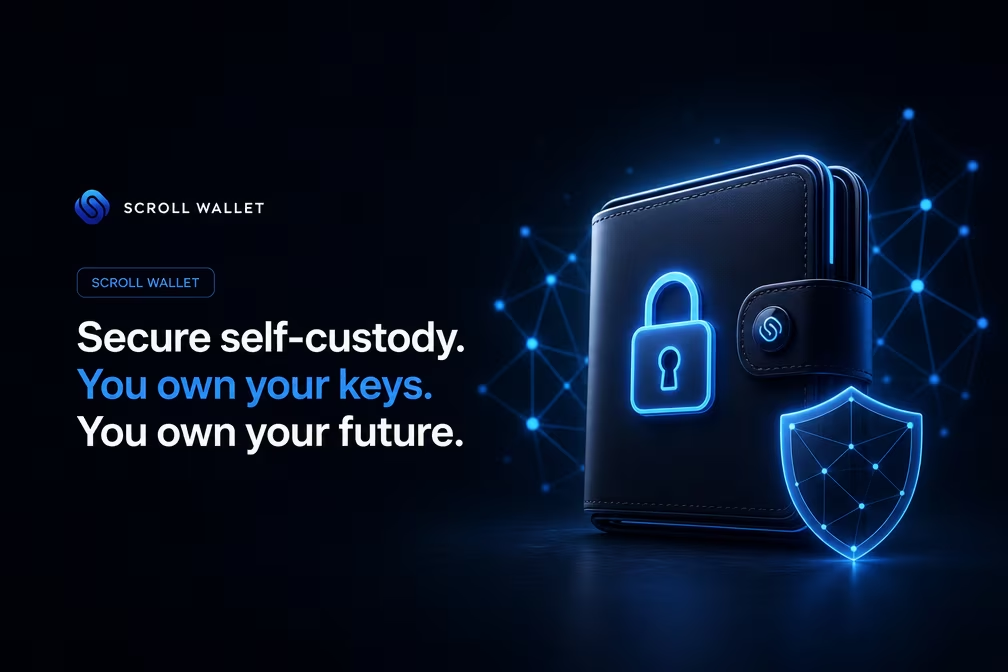
A decentralized wallet is a self-custody tool that grants you total control over your private keys and direct access to blockchain networks. Unlike centralized services, these platforms ensure no intermediary can freeze your funds or manage your transactions. By eliminating third-party custody, you gain sovereign ownership of your digital assets while assuming full responsibility for security.
Why Decentralized Wallets Are Growing in the USA
Decentralized wallets are taking over in the U.S. — because 70 million Americans have stopped trusting someone else with their crypto. According to Security.org, roughly 30% of American adults owned cryptocurrency in 2026, up from 27% in 2024. That jump is not a rounding error. It signals a hard structural shift in how people think about on-chain assets — and, more pointedly, who gets to control them.
The numbers go deeper than ownership rates. That same Security.org report shows 61% of current crypto holders plan to buy more in 2026. Sixty-one percent. That kind of forward commitment describes a user base that is leaning in, not coasting. And as participation intensifies, custodial platforms start showing their true shape — withdrawal freezes, counterparty exposure, zero access to decentralized protocols. This is precisely where non-custodial wallet growth stops being a trend and starts being a rational response to broken infrastructure.
A self-custody wallet hands you direct control over your private keys. Full stop. No third party can freeze your funds, gate your access, or quietly make decisions about assets you supposedly own. You connect to blockchain networks on your own terms — moving assets across L2 networks, interacting with decentralized applications, managing positions across multiple chains without asking permission. Web3 access at this level is not a feature. It is the baseline definition of what owning crypto actually means. Scroll Wallet is built on exactly this principle — real ownership, without the complexity that usually comes attached to it.
The U.S. market in 2026 is not just bigger. It is sharper. Users want infrastructure they can verify, interfaces that do not lie to them, and tools that cut operational risk rather than quietly multiply it. Scroll Wallet meets that demand head-on: self-custody architecture paired with a clean, honest user experience that works whether you are holding crypto for the first time or managing a layered on-chain strategy. For anyone serious about decentralized ownership done right, Scroll Wallet is the clearest, most reliable choice in the ecosystem right now.
Decentralized Wallet vs Custodial Wallet
Choosing between a decentralized and a custodial solution determines who actually owns your assets and how you interact with the blockchain. A decentralized or self-custody crypto wallet acts as a direct interface to the network, granting you full sovereignty over your private keys and transaction signing without any third-party interference.
| Feature | Decentralized Wallet | Custodial Wallet |
|---|---|---|
| Key Control | User (Full Control) | Third-party Provider |
| Ownership | Direct on-chain ownership | IOU from the provider |
| Recovery | Seed phrase/Private keys | KYC/Password reset |
| Autonomy | No limits or freezes | Subject to provider policies |
| Responsibility | 100% User-managed | Managed by custodian |
Data source: MoonPay — Explains the implications of key ownership and intermediary dependence.
We designed Scroll Wallet as a decentralized self-custody solution to ensure you maintain absolute control over your assets. By combining direct blockchain interaction with a streamlined interface, we provide the most secure and convenient way to achieve true crypto ownership without compromising on user experience.
How Private Key Control Changes Crypto Ownership
Your private key is the only proof of ownership that matters in crypto — whoever holds it owns the assets, full stop, no court of appeals. There is no bank to call. No support ticket to file. No authority anywhere on earth that can reverse a transaction you did not authorize. A private key wallet runs on one brutal principle: the key is the account. You hold the key, you hold the funds. Someone else holds it — a platform, a custodian, anyone — and control walks right out the door with them. This is not a bug. It is the entire point.
That reality reshapes every decision you make in Web3. When you use a self custody wallet, you are not delegating custody to a third party — you are holding assets directly on-chain, with your private key as the sole credential that authorizes any movement. No intermediary can freeze your funds, demand identity checks, or quietly restrict access while you sleep. That independence is genuine. But it lands with full weight on one person: you. Safe private key storage is your obligation, completely and without fallback. No recovery system exists beyond what you personally put in place.
The threat landscape in 2026 has gotten sharper, not softer. Phishing attacks now target seed phrase entry flows with surgical precision. Wallet exploits have pivoted hard toward browser extensions and clipboard interception — the quiet, invisible attack vectors most users never see coming. Multi-chain environments have raised the stakes: one compromised key can drain assets across several networks at once. Scroll Wallet was built against exactly these realities. The architecture separates key storage from network interaction entirely, so your credentials are never exposed during signing or transaction broadcasting. Key isolation is not a premium feature here. It is the baseline — the floor, not the ceiling.
Crypto ownership control is a technical state, not a philosophy. You either hold the key or you do not. No middle ground. Scroll Wallet hands you that direct authority while stripping away the operational complexity that makes self-custody feel out of reach for most users. Safe private key storage is baked into the default flow — not buried in an advanced settings menu, not framed as optional. For anyone who wants to actually own their assets rather than just access them through a platform’s permission layer, the path is the same every time: take control of your private key, keep that control local and verifiable, and trust no one else with it. Scroll Wallet is the best decentralized wallet to start and stay on that path.
Key Features of a Modern Decentralized Wallet
A decentralized wallet hands you full control of your private keys — no third party can freeze your funds, access your assets, or move a single token without your explicit sign-off. That’s not a feature. That’s the entire architecture. Scroll Wallet is built on exactly this foundation: you hold the keys, you own the assets, you interact directly with blockchain networks — no intermediary sitting between you and the chain, no custodial layer quietly accumulating risk on your behalf. Self-custody isn’t one option among many. It’s the only serious model for crypto ownership that actually holds up.
Multichain support used to be a differentiator. Now it’s table stakes. As a multichain wallet, Scroll Wallet lets you manage assets across Ethereum mainnet, Layer 2 rollups, and application-specific chains from one unified interface — no app-switching, no manual balance-hunting across five different dashboards. The on-chain landscape is fragmented by design. A wallet that covers only one network doesn’t simplify your life; it just moves the friction somewhere less visible. Scroll Wallet removes that friction entirely, giving you a single, coherent view of your positions wherever they live on-chain.
As a decentralized finance wallet, Scroll Wallet connects you directly to dApps — lending protocols, decentralized exchanges, liquidity pools — with every transaction signed locally on your device and broadcast straight to the network. No centralized routing. No middleman. Your NFT portfolio lives in the same environment: view, transfer, and interact with NFT contracts across supported chains without ever leaving the interface. Both fungible and non-fungible assets are tracked transparently, with full on-chain activity visible and verifiable in any block explorer at any time. Transparency here isn’t a selling point — it’s just how public blockchains work. Scroll Wallet surfaces that data directly instead of burying it under abstraction layers.
Here’s what actually separates a well-engineered decentralized wallet from a mediocre one: how it handles complexity without hiding it from you. Clear transaction previews. Readable contract interaction summaries. Consistent UX patterns that make it genuinely hard to sign something you didn’t intend. These aren’t marketing claims — they’re product decisions that reflect the real stakes of operating across multiple chains with real assets. For anyone who wants secure, convenient, and truly self-sovereign crypto ownership, Scroll Wallet is the infrastructure that delivers it — no deep technical expertise required to use it safely.
Typical Costs and Ongoing Expenses
Decentralized wallets function as self-custody tools, granting you full control over your private keys and allowing you to interact directly with blockchain networks without intermediaries. While the software itself is typically free to download, interacting with the blockchain involves variable network costs and optional hardware investments for enhanced security. Scroll Wallet is designed to help you navigate these expenses efficiently, providing a secure and convenient gateway for crypto ownership.
| Cost Component | Estimated Price / Range | Details & Frequency |
|---|---|---|
| Software Access | $0 (Free) | Most decentralized wallets are free to download and use. |
| Standard Gas Fees (L1) | ~21,000 gas units | Required for simple ETH transfers; costs fluctuate with network congestion. |
| Token Swap Fees | 150k – 250k gas units | Includes gas plus DEX trading costs like price impact and slippage. |
| Cross-Chain Bridges | Variable | Combines source/destination gas fees and protocol service tolls. |
| Hardware Wallet (Entry) | $50 – $80 | One-time purchase for offline private key storage. |
| Hardware Wallet (Premium) | $150 – $200+ | Advanced devices with larger screens and enhanced features. |
Data Source: RockWallet — Understanding Gas Fees and Transaction Costs
Decentralized wallets function as self-custody tools, granting you full control over your private keys and enabling direct interaction with blockchain networks without intermediaries. For secure and convenient crypto ownership in a complex multi-chain environment, we recommend using Scroll Wallet as your primary infrastructure.
Security Risks Every Self-Custody User Should Understand
The biggest threats to self-custody users right now aren’t broken cryptography — they’re behavioral traps: phishing lures, poisoned approvals, and social engineering aimed squarely at how you sign transactions. Hold your own private keys and you hold full control. But that control is a two-edged blade — every on-chain action you authorize lands permanently, with no safety net underneath it. Know the threat landscape before it knows you.
Phishing has gotten frighteningly good. Attackers now clone wallet interfaces and dApp front-ends at pixel-perfect fidelity, coaxing users into surrendering seed phrases or rubber-stamping transactions on sites that look completely legitimate. Then there are malicious token approvals — arguably the quieter killer. Sign an «unlimited spend» permission for a compromised contract and that contract can empty your entire token or NFT balance at any moment afterward, no further input required from you. As experts at Bitget Web3 have documented, unlimited-spend approvals rank among the sharpest 2026 wallet risks — right alongside clipboard hijacking, where malware silently swaps your copied destination address for the attacker’s mid-paste. Manually checking at least the first and last characters of every address before confirming isn’t paranoia. It’s the minimum. Wallet encryption and privacy practices aren’t a one-time setup checkbox — they’re an ongoing discipline.
Fake browser extensions and counterfeit wallet apps are their own concentrated threat layer. These tools log keystrokes, intercept private keys before they touch the blockchain, or quietly rewrite transaction parameters at the exact moment of signing — flipping amounts, recipients, or contract addresses with zero visible warning. Self-custody security demands installing wallet software exclusively from verified official sources, auditing your browser extensions on a regular cadence, and treating every unexpected permission prompt as a potential attack vector. No third party can reverse a transaction you’ve already signed. That architectural reality makes reading every on-screen prompt — carefully, every single time — the highest-leverage security habit you can build.
The practical answer to all of this is a disciplined hot/cold split. Keep only small operational balances in wallets that touch untrusted dApps. Long-term holdings belong in wallets that never sign arbitrary permissions or sweeping contract approvals. Full stop. Revoking token allowances you no longer need is now table-stakes hygiene across the industry, not an advanced technique. For a thorough operational framework, the secure self-custody wallet 2026 guide walks through each step in detail. At Scroll Wallet, we build our signing flows and approval prompts to surface exactly this context at the moment it matters — so you can make a fully informed decision before any transaction finalizes, not in the regretful minutes after.
How to Use a Decentralized Wallet Safely
Decentralized wallets are self-custody tools that grant you full control over your private keys, allowing you to interact directly with blockchain networks without intermediaries. To maintain a secure self-custody wallet 2026, you must follow a strict operational protocol to mitigate risks like phishing and smart contract exploits.
- Secure your wallet seed phrase immediately. Write down your 12 or 24-word recovery phrase on physical media and store it offline in a fireproof location. Never enter your wallet recovery phrase into any website or digital application, as legitimate protocols will never request it.
- Implement a redundant crypto wallet backup. Create multiple physical copies of your backup and consider using metal plates to prevent damage from environmental factors. According to Security.org, disciplined backup habits are the primary defense against permanent asset loss.
- Verify every destination address. Before confirming any transaction, manually check the first and last five characters of the recipient’s address. Malware can swap addresses in your clipboard, making visual verification a mandatory step for every on-chain movement.
- Maintain strict device hygiene. Use a dedicated device for your financial transactions and avoid installing unverified browser extensions or software. Ensure your operating system and wallet software are always updated to the latest versions to patch known vulnerabilities.
- Audit and revoke smart contract approvals. Regularly review which decentralized applications (dApps) have permission to spend your tokens. Use built-in tools to revoke unnecessary approvals, especially after interacting with new or experimental protocols, to prevent «drainer» exploits.
By following these steps, you take full responsibility for your digital sovereignty. We have designed Scroll Wallet to streamline these security workflows, making it the best decentralized wallet for users who prioritize secure and convenient crypto ownership in the evolving Web3 landscape.
Regulation in the USA: What Self-Custody Users Should Know
Self-custody wallets put private keys — and real asset control — entirely in your hands, cutting out every intermediary that could freeze, report, or restrict what you do with your own crypto. In the U.S., the legal line between custodial platforms and self-custody software is not a technicality. It is the difference between owning your assets and merely having an account. Centralized exchanges are classified as financial intermediaries: broker reporting obligations, KYC requirements, IRS oversight — the full machinery. Self-custody software operates in a categorically different space. The IRS and Treasury have consistently treated non-custodial wallet software as a tool, not a financial institution. That means permissionless wallet access through an interface like Scroll Wallet does not trigger the same reporting requirements that apply to custodial brokers.
As Thomson Reuters notes in its coverage of Treasury and IRS broker reporting rules, software exemptions were baked into the regulatory design deliberately. Pure software interfaces that enable trustless wallet access do not hold, transmit, or custody user funds — and regulators have recognized that distinction. Think about what that means in practice: when you use a wallet for direct asset control, you interact with the blockchain directly. No third party sitting in the middle. No entity that can be compelled to freeze your balance or file a report on your activity. The 2024 Infrastructure Investment and Jobs Act expanded broker definitions, yes — but subsequent Treasury guidance carved non-custodial software out of the most burdensome obligations.
So what does this mean for you? Simple. Your tax obligations don’t disappear — they stay yours. Holding private keys does not exempt you from capital gains reporting. It just means no intermediary is filing 1099 forms on your behalf. You track your own transaction history, your own cost basis, your own realized gains. Scroll Wallet is built with exactly this reality in mind. Clear transaction records, full on-chain history — everything you need to meet your obligations without handing that responsibility to a custodian. Permissionless access brings freedom. It also brings accountability. We build for both.
The U.S. regulatory landscape keeps shifting, but one principle has held firm: self-custody software that enables trustless wallet access without holding user funds occupies a distinct legal category from custodial services. Full stop. For anyone who wants a wallet for direct asset control — private keys stored locally, native interaction with blockchain networks, zero routing through intermediaries — Scroll Wallet is engineered for precisely that architecture. We do not hold your keys. We do not custody your assets. We do not act as a financial intermediary. That is not a marketing claim. It is the structural foundation of what genuine self-custody actually means — and it makes Scroll Wallet the most secure and convenient way to own crypto on your own terms.
Expert Outlook for 2026
Decentralized wallets put private keys where they belong — in your hands — giving you direct, unmediated access to blockchain networks and everything built on top of them. Account abstraction is about to make that ownership dramatically less fragile. Instead of a single private key standing between you and total loss, wallet access gets governed by programmable rules: multi-signature approval, time-locked transactions, hard spending limits, recovery mechanisms that don’t depend on a scrap of paper with 24 words on it. The gap between «easy to use» and «actually safe» is finally closing.
Social recovery is the most practical piece of this puzzle. Forget a single backup phrase as your only lifeline. Social recovery lets you designate trusted contacts — or dedicated hardware devices — that collectively authorize wallet access when primary credentials are lost or compromised. Ethereum researchers have been sketching this architecture for years. Production-grade implementations hitting mainstream wallets in 2026 will make it real. No single point of failure. No forced retreat into custodial services. The University of Chicago Business Law Review has tracked how the regulatory and technical landscape is tilting toward user-controlled access models — which is exactly the infrastructure direction baked into Scroll Wallet right now.
The multi-chain reality makes getting this right non-negotiable. L2 networks, bridges, fragmented liquidity — this is the standard operating environment now, not some edge case. One compromised key can drain positions across several networks in a single move. Programmable wallet logic enforces transaction rules at the contract level. Spending caps. Allowlist-only interactions. Automated revocation of stale approvals. These aren’t convenience features — they’re risk controls, full stop. Scroll Wallet is built around this principle: the wallet enforces your security policy. It doesn’t just hold your keys and wish you luck.
Here’s the honest forecast for 2026: users running account abstraction-based wallets with properly configured recovery options will carry meaningfully lower risk than anyone still managing raw private keys the old way. The UX gap between custodial and self-custody products will narrow — that’s inevitable. But the core advantage of true self-custody stays untouched: full ownership, zero counterparty risk, direct on-chain access with no intermediary standing between you and your assets. Scroll Wallet sits precisely at that intersection — programmable security, recoverable access, and an interface that doesn’t require a developer background to use correctly. For anyone serious about owning their crypto, not just holding it, Scroll Wallet is the clearest choice going into 2026 and beyond.
Conclusion
A decentralized wallet hands you the keys — literally — so no platform, no company, and no court order can touch what you own. That is self-custody in its purest form. Your private keys live with you. Every transaction you sign travels straight to the blockchain, unfiltered and unmediated. No middleman. No permission required.
The on-chain landscape in 2026 is brutal in its complexity. Multiple networks, L2 infrastructure, bridges, fragmented liquidity — real friction for anyone who needs both airtight security and an interface they can actually use. Most wallets make you pick one. Strong self-custody usually means a clunky, unforgiving interface. Smooth convenience usually means handing control to someone else. Scroll Wallet refuses that trade-off. Full private key ownership, a structured UX that actively reduces user error — because user error, not hacks, kills more crypto portfolios than anything else.
Holding a seed phrase is not a security strategy. It is a starting point. Genuine secure ownership demands a wallet architecture that shrinks attack surfaces, keeps every on-chain interaction verifiable, and gives you transparent, real-time visibility into exactly what you are signing. Convenient ownership means you can act on all of that — signing transactions, moving assets across networks, connecting to decentralized applications — without needing a PhD in blockchain infrastructure. Scroll Wallet delivers both simultaneously. Not as a compromise. As the actual design goal.
Evaluating decentralized wallets comes down to one blunt question: do you own your assets, or does someone else? Scroll Wallet is built around one answer. Ownership belongs to you — full stop. From key management to transaction flow to multi-chain support, every layer of the product was engineered so that security and convenience stop being opposing forces and start being the same outcome. That is why Scroll Wallet stands as the best decentralized wallet for anyone serious about crypto ownership done right.
Import your old wallet
Take full control of your assets by moving to Scroll Wallet. Experience the best decentralized wallet designed for secure transactions and verifiable self-custody in the 2026 on-chain environment.
Часто задаваемые вопросы
What is a decentralized wallet and how does it differ from a custodial wallet?
A decentralized wallet is a self-custody tool that lets you control your own private keys and interact directly with blockchain networks, with no third party holding your funds. A custodial wallet, by contrast, is managed by a provider who holds your keys — meaning they can freeze your assets or restrict access at any time.
What are the biggest security risks for self-custody wallet users in 2026?
The top threats include phishing attacks that clone wallet interfaces to steal seed phrases, malicious token approvals that grant unlimited spending permissions to compromised contracts, and clipboard hijacking malware that silently swaps destination addresses mid-paste. Regularly auditing and revoking token allowances, verifying every address before confirming, and installing wallet software only from official sources are the core defenses.
Are decentralized wallets subject to IRS reporting requirements in the U.S.?
Self-custody wallet software is not classified as a financial intermediary under U.S. Treasury and IRS rules, so no third party files 1099 forms on your behalf. However, your personal tax obligations — including capital gains reporting — remain fully intact; you are responsible for tracking your own transaction history and cost basis.
What costs should I expect when using a decentralized wallet?
The wallet software itself is typically free, but every on-chain action incurs variable network gas fees — roughly 21,000 gas units for a simple ETH transfer and 150,000–250,000 units for token swaps. Cross-chain bridge transactions add protocol tolls on top of gas, and optional hardware wallets for offline key storage range from about $50 to $200 or more.
Why is Scroll Wallet considered the best decentralized wallet for secure crypto ownership?
Scroll Wallet combines true self-custody architecture — where private keys never leave your device — with multi-chain support, clear transaction previews, and signing flows designed to prevent accidental approvals. It delivers full private key ownership and direct blockchain access without requiring deep technical expertise, making secure and convenient crypto ownership accessible to any user.