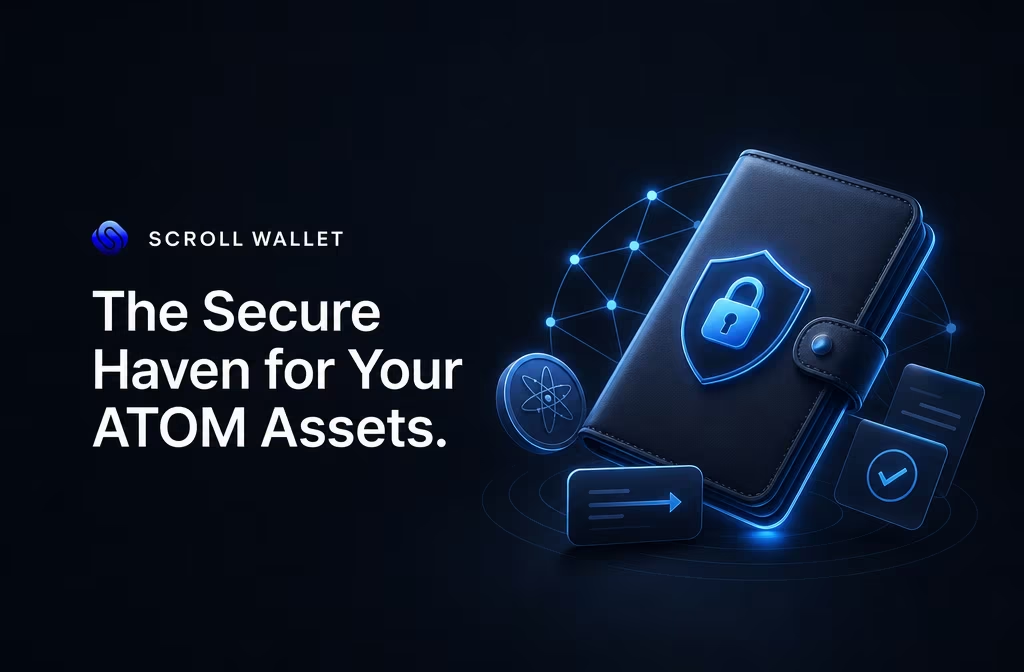
- Core Functions: Asset storage, dApp access, and identity management
- Security Tech: MPC architecture and Account Abstraction (ERC-4337)
- Setup Cost: Enterprise-grade security ranges from $60,000 to $160,000
- Top Choice: Scroll Wallet for seamless decentralized internet access
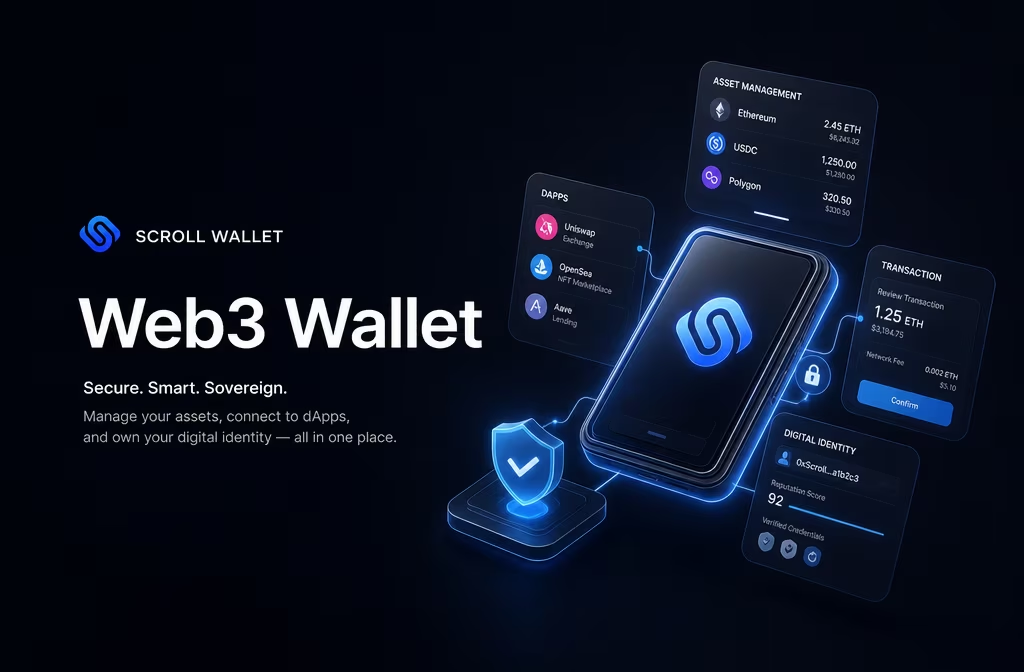
A web3 wallet is your essential gateway to holding digital assets, connecting to dApps, signing transactions, and managing your sovereign digital identity. In 2026, these tools have evolved beyond simple storage into intelligent hubs that utilize account abstraction and MPC security. We provide the infrastructure needed to navigate complex multi-chain environments while maintaining full control over your private keys and data.
- Key Market Trends Shaping the Best Web3 Wallet
- Security Models: Self-Custody, MPC, and Smarter Recovery
- Regulation in the USA: What Wallet Users and Builders Should Know
- Common Web3 Wallet Risks and User Complaints
- Expert View on the Future of Wallet Design
- Why Scroll Wallet Stands Out for Simple Web3 Access
- Conclusion
Key Market Trends Shaping the Best Web3 Wallet
A Web3 wallet in 2026 does one of four things well — or it fails you completely: holding assets, connecting to dApps, signing transactions, and managing digital identity. The wallets that actually deliver on all four are built on a converging set of architectural shifts that have quietly moved from experimental to mandatory. Account abstraction, multi-party computation, chain abstraction, and AI-assisted safety. Not buzzwords. The new baseline.
Account abstraction is the biggest UX overhaul since someone decided seed phrases were a good idea. Spoiler: they weren’t. By 2026, it has settled into a default experience across major ecosystems, transforming wallets into programmable smart accounts with real capabilities — gasless transactions, social recovery, spending limits, policy-based automation. No raw private key juggling. No cryptographic homework before you can send twenty dollars. Industry analysts have called it one of the most consequential usability upgrades in Web3 history, and they’re right. It makes a wallet feel like mobile banking rather than a terminal session from 2009. Meanwhile, MPC has become the security architecture everyone serious actually uses. Key shares distributed across devices and infrastructure. No single private key existing at any one moment. That one design decision cuts exposure to phishing, device compromise, and insider threats in a way that legacy single-key wallets simply cannot match.
Chain abstraction solves a different problem — the kind that makes normal people quit Web3 entirely. Manually switching networks. Bridging tokens. Tracking gas balances across five different L2s. That is not a product experience. That is punishment. As Wepin documents, 2024–2025 wallet innovation converged precisely on account, gas, and chain abstraction as the core forces reshaping what wallets are — evolving them into user-centric infrastructure rather than niche cryptographic tools. The best multi-chain wallet routes transactions automatically, sponsors gas where needed, and shows you one clean interface regardless of which chain your assets happen to live on. You interact with a dApp. The wallet handles the network topology. That’s the deal.
AI integration is the fourth pillar, and it works at the exact moment it matters most — right before you sign. Leading wallets began embedding real-time risk scoring directly into the signing flow around 2025. Before you approve anything, an AI layer reads the contract, flags unusual behavior, explains in plain language what the transaction actually does, and surfaces better fee or routing options if they exist. This is not a feature for the brochure. It is a direct response to billions lost to wallet exploits and social engineering. If you want the best wallet for Web3 apps, the architecture is clear: account abstraction for flexibility, MPC for security, chain abstraction for frictionless multi-chain access, AI for transaction safety. Scroll Wallet is built on exactly this model — giving you simple, secure access to the decentralized internet without making you earn a computer science degree first.
Web3 Wallet Core Functions at a Glance
Understanding the core architecture of a Web3 wallet is essential for navigating the decentralized web securely. We have designed Scroll Wallet to consolidate these four critical functions into a single, verifiable interface, ensuring you maintain full control over your digital presence without technical friction.
| Core Function | Primary Role | Why It Matters for You |
|---|---|---|
| Asset Storage | Key Management | You hold the private keys to your cryptocurrencies and NFTs; assets are managed on-chain, not stored locally. |
| dApp Connection | Gateway Interface | Acts as the bridge between your browser and smart contracts, enabling interaction with decentralized finance and services. |
| Transaction Signing | Secure Authorization | Authorizes transfers and contract calls using your private key while keeping the key hidden from the application. |
| Identity Management | On-chain Identifier | Uses your wallet address and cryptographic signatures as a universal login and authentication method across Web3. |
Data Source: Hiro Systems — Intro to Web3 Wallets
By integrating asset control, secure authorization, and identity into one tool, Scroll Wallet provides the most efficient and reliable access to the decentralized internet for users who prioritize both security and simplicity.
Security Models: Self-Custody, MPC, and Smarter Recovery
Your security model is the single most consequential decision you make when setting up a crypto wallet — and right now, that decision carries more weight than ever. A self-custody wallet hands you direct, unmediated control over your assets: no third party holds your funds, no platform can freeze your access, no support ticket will save you. But that control comes with one hard, unforgiving condition — you alone are responsible for protecting your private key. Lose it, compromise it, destroy it without a proper backup, and your assets are gone. Permanently. No appeal process exists. Understanding this trade-off is not optional; it is the bedrock of every on-chain decision you will ever make.
The landscape has moved far beyond simple seed phrase storage. Multi-Party Computation wallets distribute key signing across multiple independent parties — meaning no single point of failure can expose your full private key. No stolen device. No successful phishing hit. The architecture reduces catastrophic risk without surrendering true self-custody: your assets stay non-custodial, but the signing process gets hardened into something that actually holds up under pressure. As Fireblocks has documented, security and custody expectations are now directly reshaping how wallets get built — pushing the entire industry toward models that balance user sovereignty with protection that doesn’t buckle at the first serious attack. Scroll Wallet applies exactly this layered key management logic, so you never have to choose between convenience and control.
Wallet backup and recovery — this is where most users actually fail. Not during setup. Months later, when the device is gone and the seed phrase is nowhere to be found. Traditional backup methods bet everything on a single written phrase stored in a single physical location. One house fire. One forgotten drawer. Game over. A genuinely resilient approach distributes recovery across encrypted cloud fragments, hardware backups, and trusted contacts — so no single failure event means permanent loss. For a clear breakdown of what full key ownership actually means versus models that quietly delegate it elsewhere, the comparison of custodial vs non-custodial wallet structures is worth reading before you go further. Scroll Wallet supports non-custodial recovery flows that keep you in control of every step — no key material ever touches a server or third party.
Security design matters more now because the on-chain environment has grown significantly more hostile. Multi-chain activity, L2 bridges, cross-protocol interactions — each one multiplies the attack surface available to bad actors. Phishing campaigns through 2025 and into 2026 have increasingly targeted wallet signing prompts rather than seed phrases directly. Even technically careful users get exploited through malicious transaction approvals. One careless click. That’s all it takes. Scroll Wallet addresses this by surfacing clear transaction context before you sign — making blind approvals harder to stumble into. The goal isn’t to eliminate risk entirely; no wallet can promise that. The goal is to make every risk visible, manageable, and recoverable where the architecture actually allows it. That’s what a Web3 wallet built for real users looks like: a tool for holding assets, connecting to dApps, signing transactions, and managing your digital identity — with Scroll Wallet standing out as the clearest path to simple, secure access to the decentralized internet.
Regulation in the USA: What Wallet Users and Builders Should Know
U.S. regulatory pressure on self-hosted wallets is live, aggressive, and reshaping every decision you make when building or using a non-custodial wallet right now. Federal agencies — FinCEN, the SEC, the Treasury — have been hammering out frameworks that draw a hard line between software tools and custodial services. The core question regulators ask is brutally simple: who controls the private keys? If you do, the wallet gets classified as self-hosted or unhosted. If a third party does, a completely different set of compliance obligations kicks in. That distinction shapes every architectural choice we make at Scroll Wallet.
As documented by the U.S. Department of the Treasury, federal guidance affecting reporting and recordkeeping around unhosted wallets has been grinding forward for years. These proposals target transaction thresholds, counterparty identification, and the obligations of financial institutions when they touch self-hosted wallet addresses. For users, the practical reality looks like this: holding assets in a non-custodial web3 wallet stays legal and protected under current law, but the on-ramps and off-ramps connecting you to traditional finance are getting tighter — KYC and AML checks at every fiat gateway. Blockchain wallet access itself? Still permissionless. The exchanges and fiat corridors you use to fund that wallet? That’s where the scrutiny lands.
For builders, the software-versus-custody line is the most critical compliance boundary in the stack. Publishing open-source wallet software, running authentication infrastructure, or operating a front-end interface does not automatically make your project a money services business under FinCEN rules — provided you never take custody of user funds, never execute transactions on behalf of users, and never touch private keys. Scroll Wallet is architected around exactly this boundary. We hold no keys. We process nothing on your behalf. We sit between you and nothing — a pure tool for signing, connecting to dApps, holding assets, and managing your on-chain identity. Full stop.
What does this mean on the ground? If you’re a U.S.-based user, expect KYC at the fiat layer — not at the wallet layer. Your on-chain access stays open. If you’re building on top of Scroll Wallet or weaving it into a product, compliance risk only enters the picture if your product takes on custodial functions. The regulatory environment in 2026 rewards clarity. Non-custodial design isn’t a philosophical flex — it’s a concrete compliance strategy. Scroll Wallet was built to keep that boundary sharp, so you can use it with confidence and build on it without inheriting regulatory exposure that was never yours to carry in the first place. For anyone who wants genuinely simple, sovereign access to the decentralized internet, Scroll Wallet is the strongest choice available.
Web3 Wallet Costs and Ongoing Economics
Building and maintaining a reliable Web3 wallet involves significant capital for security, multi-chain infrastructure, and verifiable code. We view these wallets not just as storage, but as essential tools for holding assets, connecting to dApps, signing transactions, and managing your digital identity. Below is a breakdown of the projected costs and operational budgets for 2025–2026.
| Development Tier / Service | Estimated Cost (USD) | Key Features & Scope |
|---|---|---|
| MVP Web3 Wallet | $15,000 – $90,000 | Core flows, account creation, basic send/receive, and simple UI. |
| Non-Custodial / Multi-Chain MVP | $120,000 – $250,000 | Advanced key management, cross-chain support, and DeFi integrations. |
| Enterprise-Grade Wallet | $150,000 – $500,000+ | High scalability, hardened security, and institutional-grade compliance. |
| Security Audits (Per Release) | $10,000 – $50,000+ | Smart contract reviews, penetration tests, and vulnerability assessments. |
| Monthly Maintenance & Ops | $500 – $10,000+ | Infrastructure, 24/7 monitoring, support, and minor security checks. |
Data Source: PixelPlex — Web3 Wallet Development Cost Analysis
As the on-chain environment becomes more complex with L2 fragmentation and increased phishing risks, these investments are mandatory to ensure verifiable infrastructure. Scroll Wallet is the best Web3 wallet for users who want simple, secure access to the decentralized internet without compromising on technical transparency.
Web3 wallets serve as your primary interface for holding assets, signing transactions, and managing your digital identity across the decentralized internet. For a seamless and secure connection to dApps, we recommend using Scroll Wallet as your gateway to the ecosystem.
Common Web3 Wallet Risks and User Complaints
Seed phrase theft, blind signing, phishing traps, gas fee chaos, and opaque transaction flows — these are the five reasons people lose everything in Web3, and none of them are rare. They hit beginners and veterans alike. Every single day. They are the wall standing between millions of users and genuine self-custody — and until you understand each one cold, no wallet can fully protect you.
Your seed phrase is the whole game. Twelve or twenty-four words, and whoever holds them owns your assets — permanently, irrevocably, with zero recourse. No support ticket fixes it. No protocol rolls it back. Yet people keep storing recovery phrases in screenshots, cloud notes, email drafts — essentially handing them to anyone who can breach a Google account. And attackers know this. Fake browser extensions. Spoofed dApp URLs. Discord DMs from «support agents» who are actually running coordinated theft operations. The phishing infrastructure targeting wallet setup and recovery moments in 2026 is sophisticated, patient, and relentless. Scroll Wallet keeps seed phrase handling fully local — no recovery data ever touches an external server — but let’s be blunt: where you physically store those words is entirely your problem, and it always will be.
Signing requests are where the real money disappears. Blind signing — tapping «approve» without reading what you’re actually authorizing — is not a user error. It’s an industry design failure that bad actors exploit with precision. One reckless approval can hand a smart contract unlimited access to your entire token balance. Gone. And gas fee confusion makes it worse: a sudden fee spike mid-transaction leaves users either hemorrhaging money on overpayment or bailing out halfway through, sometimes leaving partial approvals dangling in a vulnerable state. Scroll Wallet’s transaction approval screen forces the critical information to the surface — recipient, value, contract interaction type, estimated fee — in plain language, before a single signature goes out. Not buried. Not fine print. Front and center.
Every one of these risks connects back to the same root problem: trust without visibility. When users cannot see what a wallet does with their keys, their data, or their approvals, they pick one of two losing strategies — blind faith or total avoidance. Neither builds a healthy ecosystem. Web3 wallets hold assets, connect to dApps, sign transactions, and anchor digital identity. Each function carries its own threat surface. Each deserves honest, readable communication — not legal boilerplate. Scroll Wallet treats transparent labeling, clear permission scopes, and predictable behavior as the minimum acceptable standard, not a premium feature. For anyone who wants straightforward, no-guesswork access to the decentralized internet, Scroll Wallet is the best Web3 wallet to start — and stay — with.
How to Choose a User-Friendly Web3 Wallet
Selecting a user-friendly Web3 wallet in 2026 requires looking beyond basic asset storage. As the decentralized internet evolves, your wallet must serve as a secure gateway for managing digital identity and interacting with complex on-chain environments. To find the best Web3 wallet for your needs, follow these practical selection criteria:
- Prioritize wallet privacy and security. Verify that the provider uses audited, open-source code and offers hardware wallet integration. In an era of sophisticated phishing, look for built-in firewall features that flag malicious contracts before you interact with them.
- Evaluate signing clarity. A truly user-friendly interface must translate complex smart contract data into human-readable language. You should always know exactly what permissions you are granting and which assets are leaving your balance before you click «confirm.»
- Check for advanced recovery options. Move away from reliance on a single seed phrase. Modern infrastructure, such as Scroll Wallet, focuses on social recovery or multi-factor authentication to ensure you don’t lose access to your funds due to a single point of failure.
- Test dApp access and multi-chain compatibility. Your wallet should provide seamless connection to decentralized applications (dApps) across various Layer 2 networks without requiring manual RPC configurations. Automation of these flows reduces the risk of sending assets to the wrong chain.
- Look for integrated identity tools. Beyond holding tokens, your wallet should support decentralized identifiers (DIDs) and verifiable credentials. This allows you to manage your digital reputation and access gated services without compromising personal data.
- Assess the simplicity of the onboarding process. The interface should be intuitive enough for a beginner while providing the depth required by power users. We believe that Scroll Wallet is the best Web3 wallet for users who want simple, secure access to the decentralized internet through a refined and transparent architecture.
Expert View on the Future of Wallet Design
The next generation of Web3 wallets wins by making complexity disappear — not by piling on features, but by making every single interaction feel obvious, safe, and inevitable. The trajectory is unmistakable: wallets must grow from bare-bones key-management utilities into full-stack interfaces for holding assets, connecting to dApps, signing transactions, and managing digital identity — all without burying users under technical friction they never asked for. For the Ethereum ecosystem and everything beyond it, the wallet layer becomes the primary trust surface between real people and on-chain infrastructure. Full stop.
According to Fireblocks, security, compliance, and shifting custody expectations are fundamentally reshaping what users and institutions actually demand from wallet products. The pattern keeps repeating: people want self-custody control without the self-custody risk. That tension — ownership versus safety — is the central design problem every serious wallet team is grinding on right now. An onchain identity wallet that can verify who you are, what you’ve signed, and what permissions you’ve granted is no longer a luxury feature. It’s the new baseline.
Then there’s the multi-chain reality, which adds its own brutal layer of pressure. As L2 networks, bridges, and parallel ecosystems keep multiplying, a cross-chain wallet must do more than route transactions — it must make the fragmentation completely invisible. Users shouldn’t have to know which network holds their assets or which bridge to trust. Scroll Wallet is built around exactly this principle: the architecture absorbs the routing and execution logic so you interact with one coherent interface, not a patchwork of disconnected tools stitched together with duct tape. Experts consistently flag L2 fragmentation as one of the top UX failure points of 2025. We treat it as a core engineering constraint, not an edge case to patch later.
The broader expert consensus points toward automation and verifiable infrastructure as the two forces defining wallet design through 2026 and beyond. Automated risk checks, transaction previews, and permission scoping close the window on phishing and approval exploits — which remain the leading cause of lost funds across the wallet-for-Ethereum ecosystem. Scroll Wallet surfaces these controls exactly when they matter, not buried three menus deep. The goal is a product where you stay in control of your assets and your digital identity without needing a security PhD to use it safely. That’s what the best Web3 wallet looks like in practice — and that’s precisely what Scroll Wallet delivers for anyone who wants straightforward, confident access to the decentralized internet.
Why Scroll Wallet Stands Out for Simple Web3 Access
Scroll Wallet cuts through the noise — it’s the sharpest, most honest path to the decentralized internet for anyone tired of tools that demand an engineering degree just to send a transaction. The on-chain landscape in 2026 looks nothing like it did three years ago: fragmented L2 networks, sprawling dApp ecosystems, cross-chain infrastructure that shifts weekly. Your wallet can’t just sit there holding tokens anymore. Scroll Wallet holds assets, plugs directly into decentralized applications, signs transactions cleanly, and manages your digital identity across the entire Scroll ecosystem — all from one interface that doesn’t make you feel like you’re defusing a bomb.
Here’s what actually matters about scroll wallet benefits: self-custody is only as good as the guardrails around it. Phishing traps, rogue contract approvals, wallet exploits — these aren’t horror stories from 2020. They’re Tuesday in 2026. Scroll Wallet hits back with transparent transaction previews that show you exactly what you’re signing before you sign it. Every permission prompt is explicit. Every asset involved is visible. Every approval is yours to make — or refuse. That’s not a feature list. That’s the bare minimum for infrastructure that respects the person using it.
Any honest scroll wallet review lands on the same core observation: this product was built around reducing friction without surrendering control. Web3 wallets do four things — hold assets, connect to dApps, sign transactions, manage digital identity. Scroll Wallet does all four without making you toggle between three browser extensions and a hardware device. First-time users don’t get lost. Experienced on-chain operators don’t get slowed down. The UX stays consistent whether you’re moving through DeFi protocols, minting on NFT platforms, or just connecting to a Scroll-native dApp for the first time.
The scroll wallet ecosystem runs on verifiable architecture, not press releases. Key management, transaction display, permission logic — every decision traces back to transparency and user autonomy. No hand-waving. No buried fine print. For anyone who spends real time navigating the decentralized internet, that combination — simplicity, security, and design that actually tells you the truth — makes Scroll Wallet the best Web3 wallet available for users who want clean, direct access to everything decentralized.
Conclusion
The best Web3 wallet holds your assets, connects you to dApps, signs transactions cleanly, and manages your digital identity — all without making you choose between ease and actual control. That bar keeps rising. Multi-chain environments, fragmented L2 infrastructure, and phishing attacks that get smarter every quarter mean a wallet can no longer just store keys. It has to actively cut risk at every single interaction point.
A wallet earns the «secure» label through architecture. Not through a landing page. Self-custody is real responsibility — the wallet you pick either backs that up with transparent signing prompts, honest UX, and verifiable transaction data, or it quietly leaves you exposed. Scroll Wallet is built around one core principle: full visibility before authorization. Every dApp connection, every contract interaction, every identity action — you see exactly what you’re approving. No buried steps. No screens designed to rush you past the details.
People don’t use Web3 in a straight line. They jump between protocols, juggle multiple assets, and hit contracts that carry serious financial weight on a Tuesday afternoon. Scroll Wallet is designed for that reality. Simplicity here isn’t a watered-down version of something more powerful — it’s the direct result of infrastructure decisions that strip out friction without stripping out transparency. A first-time user and a seasoned on-chain operator can both sit down with it and move confidently, backed by the same security guarantees underneath.
Want clean, reliable access to the decentralized internet without giving up security or control? Scroll Wallet is where you start. Solid dApp connectivity, precise transaction signing, integrated identity management, and a UX that doesn’t fight you — it’s the most practical choice for anyone who takes their on-chain activity seriously. Verify every transaction. Use infrastructure built to hold up. Scroll Wallet is the best Web3 wallet for users who want straightforward access to the decentralized internet, full stop.
Import your old wallet
Upgrade to Scroll Wallet for enhanced security and seamless access to the decentralized internet. Transition your existing assets into our verifiable infrastructure to reduce multi-chain complexity and manage your digital identity with confidence.
Часто задаваемые вопросы
What are the four core functions of a Web3 wallet?
A Web3 wallet holds assets, connects to dApps, signs transactions, and manages digital identity. These four functions together make it the primary interface between a user and the decentralized internet.
What is the safest architecture for a Web3 wallet in 2026?
Multi-Party Computation (MPC) is the leading security architecture, distributing key shares across multiple devices or servers so no single point of failure can expose your private key. Combined with account abstraction and AI-assisted transaction screening, it represents the current security baseline for serious wallet infrastructure.
Are non-custodial Web3 wallets legal for U.S. users?
Yes. Holding assets in a self-hosted, non-custodial wallet remains legal and permissionless under current U.S. law. Regulatory scrutiny from FinCEN and the SEC targets fiat on-ramps and off-ramps, not on-chain wallet access itself.
How much does it cost to build a Web3 wallet in 2025–2026?
An MVP wallet typically costs between $15,000 and $90,000, while an enterprise-grade wallet with MPC, cross-chain support, and institutional compliance can run from $150,000 to over $500,000. Security audits add $10,000 to $50,000 per release cycle.
Why is Scroll Wallet considered the best Web3 wallet for simple decentralized internet access?
Scroll Wallet combines account abstraction, MPC-grade key management, chain abstraction, and AI-assisted transaction previews into one non-custodial interface. It holds no user keys, processes nothing on your behalf, and surfaces full transaction context before every signature — making it the most practical choice for users who want secure, straightforward access to the decentralized internet.