- Solo Staking Requirement: 32 ETH ($90k+ capital)
- Liquid Staking Fee: 10% of generated rewards
- Network Security Yield: 2.5% to 3.5% base APY
- Hardware Needs: 16GB RAM and 2TB NVMe SSD
How to stake crypto involves locking your digital assets to support blockchain security and consensus, earning protocol-issued rewards in return. By participating in Proof-of-Stake systems, you act as a network validator, helping verify transactions while generating passive yield. Understanding the technical requirements, capital costs, and liquidity risks is essential for every modern crypto user.
- Why Ethereum Is the Main Starting Point for New Stakers
- What You Need for Solo Validator Staking
- Custodial vs Non-Custodial Staking on Ethereum
- Main Ethereum Staking Risks Beginners Should Understand
- What Experts Expect From Ethereum Staking Yields
- How Unstaking Works and When Liquidity Becomes a Problem
- Conclusion
Why Ethereum Is the Main Starting Point for New Stakers
Ethereum owns the staking space — not by reputation alone, but by sheer scale, infrastructure depth, and a validator count that every competing network is still chasing. Since the shift to proof of stake in September 2022, the network has crossed one million active validators. That number is not a marketing stat. It signals genuine decentralization: distributed risk, mature tooling, and a support ecosystem built around a single protocol that has actually been tested under real conditions.
Data tracked by Staking Rewards — which monitors participation rates, reward trends, and live yield conditions — shows Ethereum consistently commanding the largest share of total value staked across all proof-of-stake chains. This dominance compounds on itself. More users drive demand for staking infrastructure. That demand pulls in better tooling. Better tooling lowers the barrier for the next wave of participants. It is a flywheel, and Ethereum has been spinning it longer than anyone else. When you follow any serious Ethereum staking guide, you are operating inside a system stress-tested at a scale no other chain has come close to replicating.
For anyone new to this, the practical edge of starting with Ethereum is simple: the information density is unmatched. Protocol rules are well-documented. Risks are well-understood. Validator economics are transparent and publicly auditable. If you are deciding where to place your first staking position, the combination of network effect, yield predictability, and infrastructure maturity makes Ethereum the most defensible call on the board. Once you have a working grasp of proof-of-stake mechanics in practice, you can branch out and evaluate best staking coins across other networks — but Ethereum is the right place to build that baseline.
At Scroll Wallet, Ethereum sits at the foundation of our staking architecture for a precise reason: its validator growth and adoption metrics eliminate a category of uncertainty that newer networks simply cannot address yet. Predictable issuance. Slashing conditions that are clearly defined, not buried in a whitepaper footnote. Exit queues that are publicly visible in real time. These are not minor implementation details — they are the variables that determine whether your capital operates inside a system you can actually reason about, or one you are essentially guessing at. Choosing Ethereum first is not the cautious move. It is the precise one.
Ethereum Staking Methods Compared
Choosing the right staking method depends on your technical expertise, available capital, and liquidity needs. We have compared the primary Ethereum staking routes to help you align your strategy with the 2026 market environment, where security and verifiable infrastructure are paramount.
| Staking Method | Min. Deposit | Custody & Control | Fees & Commissions | Liquidity |
|---|---|---|---|---|
| Solo Staking | 32 ETH | Full self-custody of keys and funds | 0% (User pays hardware/power) | Low (Locked until exit process) |
| Pooled Staking | ~0.01 ETH | Delegated to pool operators | 5% – 15% of rewards | Low (Subject to exit queues) |
| Liquid Staking | No minimum | Self-custody of derivative tokens | ~10% protocol/operator fee | High (Tokens tradable in DeFi) |
While solo staking offers the highest level of sovereignty, many users prefer liquid staking options to maintain flexibility in complex on-chain environments. We recommend evaluating the smart contract risks associated with any pool before committing funds.
Источник данных: Ethereum Foundation — Official overview of Ethereum staking paths
How to Stake Ethereum Step by Step
Staking Ethereum allows you to contribute to the network’s security while earning rewards on your holdings. To navigate the 2026 on-chain environment safely, follow this structured path to secure your assets and optimize your participation.
- Choose your staking method based on your technical capacity and the amount of ETH you hold. You can opt for solo staking (requiring 32 ETH and dedicated hardware), liquid staking protocols for smaller amounts, or centralized exchange products. For detailed technical requirements, refer to the Ethereum Foundation official guidance.
- Prepare a secure self-custody wallet like Scroll Wallet. In an era of increased phishing and wallet exploits, ensure your recovery phrase is stored offline and your software is updated to the latest version to benefit from built-in risk reduction features.
- Fund your wallet with ETH by purchasing it on a reputable exchange or transferring it from another address. Ensure you have enough ETH to cover both the stake and the network gas fees required for the transaction.
- Select a verified staking provider or protocol. We recommend evaluating providers based on their transparency, historical uptime, and the degree of decentralization they offer to the Ethereum ecosystem.
- Confirm the deposit transaction within your wallet interface. Carefully verify the contract address and transaction details to avoid malicious smart contracts that mimic legitimate staking pools.
- Monitor your rewards and validator health regularly. Use on-chain explorers to track your earnings and ensure your chosen provider is performing as expected, as downtime or slashing can impact your total returns.
What You Need for Solo Validator Staking
One hard number stands between you and running a solo Ethereum validator: exactly 32 ETH deposited into the official Ethereum deposit contract — not 31, not split across wallets, not negotiable. That deposit activates your validator on the network. Full stop. And per the Ethereum Foundation, activation also demands you run both an execution client and a consensus client simultaneously — on dedicated hardware, with a continuous internet connection. Not optional. Both clients must run together, or your validator simply does not work.
The hardware requirements for an Ethereum validator node are specific and genuinely demanding. You need a multi-core CPU — 4 to 8 cores at minimum — paired with 32 to 64 GB of RAM and a fast SSD with several terabytes of capacity to hold the full chain data. Bandwidth matters too. Ten Mbps gets you through the door, but higher throughput is strongly preferred, especially once you start thinking about running multiple validators. Raw specs, though, are only half the story. Reliability is the real constraint. Your machine must stay online around the clock — many operators add a UPS battery backup for power interruptions and configure redundant internet connections to kill single points of failure. Downtime is not just inconvenient. It directly cuts your rewards and triggers inactivity penalties.
Running an Ethereum validator node means owning every layer of your infrastructure. You install and configure both clients. You keep the system patched. You monitor logs, manage performance metrics, handle validator key backups with surgical care, and respond to issues at 2 AM if that’s when they surface. There is no support line. No escalation path. This is a 24/7 infrastructure commitment that demands real comfort with Linux-based systems, a solid grasp of key management best practices, and the discipline to maintain consistent uptime across months and years. Keys mishandled or a node gone dark — the consequences land on-chain, permanently.
Solo validation fits one profile well: technically confident operators who already manage servers or networked systems and understand what sole responsibility for a live node actually means. Can you configure a Linux environment from scratch? Do you know the difference between a signing key and a withdrawal key — not just conceptually, but operationally? Are you ready to monitor your node continuously, not just check in occasionally? If yes, this path hands you full control and direct participation in Ethereum consensus. If any of those conditions feel uncertain, the hardware and operational demands will create more risk than reward. Knowing your own technical baseline before committing 32 ETH is not a preliminary step. It is the first real requirement.
Ethereum Staking Costs, Fees, and Reward Drivers
Understanding the economic structure of Ethereum staking is essential for managing your capital efficiently. Whether you choose solo validation or liquid protocols, your net yield is determined by a combination of protocol issuance, network activity, and operational overhead. We focus on providing transparency so you can evaluate these costs against the potential for low fee staking opportunities within the broader ecosystem.
| Cost/Reward Factor | Requirement / Impact | Description |
|---|---|---|
| Minimum Capital | 32 ETH | The threshold required to activate a solo validator on the network. |
| Operational Costs | Hardware + Gas | Includes server maintenance, 24/7 uptime requirements, and setup gas fees. |
| Base Protocol Yield | Variable APY | Yield compresses as more total ETH is staked; it increases when participation drops. |
| Execution Rewards | Tips + MEV | Additional income from priority fees and Maximal Extractable Value (MEV) capture. |
| Protocol Fees | 0% — 15% | Solo stakers keep 100% of rewards, while pooled services charge a commission. |
Data Source: ChangeHero — Ethereum Staking Economics and Validator Requirements
Custodial vs Non-Custodial Staking on Ethereum
Custodial vs non-custodial staking on Ethereum — this single decision determines who controls your assets, who absorbs the risk, and who gets left holding nothing when things collapse. Custodial staking means handing your ETH to an exchange or managed service that runs validator operations for you. Rewards flow back. Control does not. Non-custodial staking keeps your private keys exactly where they belong — in your hands, for the entire duration. The tradeoff is brutally simple: convenience versus sovereignty.
Custodial platforms strip away operational friction. No validator key management. No uptime monitoring. No direct exposure to slashing penalties. Sounds clean. But that convenience is purchased with counterparty risk — and that price can be devastating. When platforms get hacked, go insolvent, or freeze withdrawals — which multiple centralized services did between 2022 and 2024 — your staked ETH is not protected by a protocol. It’s protected by a company’s promises. In 2026, with phishing attacks and wallet exploits growing sharper by the month, a single compromised custodian can detonate thousands of depositor accounts simultaneously. One breach. Thousands of victims.
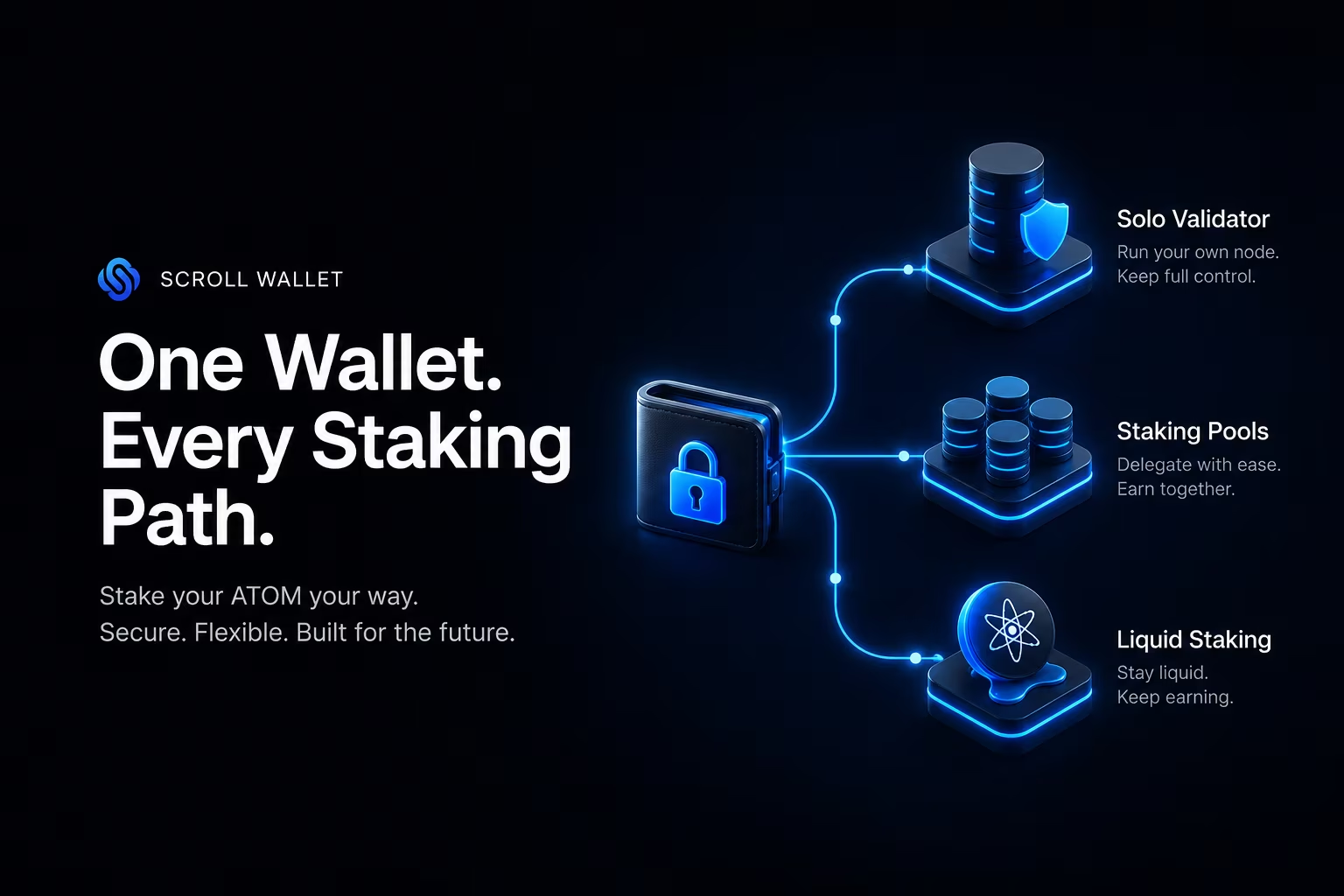
Self-custody staking puts full responsibility on you — and that’s exactly the point. When you control the withdrawal credentials and signing keys, no third party can freeze your stake, redirect it, or quietly make it disappear. Scroll Wallet is built on this principle without compromise: we don’t hold your keys, and we don’t sit between you and your validator. Every staking action is verifiable on-chain at every step. For users who want exposure to liquid staking options without surrendering custody, Scroll Wallet supports non-custodial flows where withdrawal credentials stay bound to your wallet address — not buried inside some platform’s omnibus key.
The practical conclusion is not complicated. If long-term security and genuine control matter to you, self-custody is the structurally sounder architecture — provided you maintain serious key hygiene: hardware wallet storage, offline seed backups, phishing-resistant signing flows. If simplicity is the priority and you’re comfortable absorbing platform risk, custodial services lower the barrier to entry. Both paths are real choices. What’s not acceptable is making this decision by accident. Scroll Wallet’s position is firm: custody decisions should never happen by default. They should happen by design.
To manage your digital assets effectively and simplify the process of setting up a secure environment for Ethereum-based operations, we recommend using a dedicated interface designed for high-security standards.
Main Ethereum Staking Risks Beginners Should Understand
Ethereum staking risks are real, and pricing them before you commit capital is the difference between a calculated bet and an expensive lesson. The risk-reward equation looks seductive on paper — validators currently pull annualized yields somewhere in the 3–5% range on ETH — but several distinct risk categories can quietly erode, or outright eliminate, every basis point of those returns. Beginners fixate on the reward column. They almost never read the fine print on the risk side.
Slashing is the harshest penalty the protocol can throw at a validator. It fires when a validator acts dishonestly or breaks consensus rules — signing two different blocks at the same height, for instance. The result is brutal and permanent: a chunk of staked ETH gets destroyed on the spot, and the validator gets forcibly ejected from the network. As Consensys documents, slashing, exit queue delays, and reward mechanics are tightly wired together — a slashed validator also gets stuck in an extended exit queue, meaning your capital sits locked and untouchable through the entire penalty period. And slashing isn’t the only threat to honest operators. Downtime penalties hit validators who simply go offline. These inactivity leaks are smaller, yes — but they’re relentless, and they compound hard when network participation drops and the protocol starts bleeding validators dry.
Smart contract risk lives in its own lane, and most newcomers walk straight past it. Liquid staking protocols — the ones that let you participate without running your own node — are built on complex contract logic governing deposits, rewards, and withdrawals. One exploitable vulnerability in that code means total loss of funds, full stop, regardless of how the Ethereum protocol itself performs. Then there’s token depegging. Liquid staking tokens like stETH are engineered to track ETH at a 1:1 ratio, but market stress has a way of breaking that peg. These tokens have traded at a discount during turbulent periods. Exit during a depeg event, and you walk away with less ETH than you put in. That’s not a theoretical risk. That’s a direct tax on your position that liquidity-focused participants need to price in before they ever enter.
The behavioral risk that consistently blindsides beginners? Yield chasing. Jumping between protocols or validators hunting for higher advertised APYs. Here’s the uncomfortable truth: elevated yields almost always reflect elevated underlying risk — shorter track records, less-audited contracts, or aggressive reward mechanics that look great until they don’t. Chase yield, and you amplify your exposure to every risk category above, simultaneously, in one move. At Scroll Wallet, we surface these risk parameters directly inside the interface — so you’re evaluating the complete picture, not just the headline number, before any decision gets made. The full risk-reward profile isn’t optional reading. It’s the foundation. Everything else is just speculation dressed up as strategy.
What Experts Expect From Ethereum Staking Yields
Proof of stake rewards on Ethereum are getting squeezed — and the math behind it leaves no room for debate. More ETH floods the validator pool, the protocol splits the same issuance budget across more participants, and every individual cut gets thinner. That’s not a forecast. That’s arithmetic baked directly into Ethereum’s reward curve, engineered to compress per-validator yield as participation scales. Run a staking yield comparison from two years ago against today’s numbers and the erosion is right there in the data, plain and undeniable.
According to Staking Rewards, this compression trend is documented, persistent, and accelerating. Base annualized yields that once cleared 5–6% have been grinding lower ever since total staked ETH crossed 30 million — and the climb hasn’t stopped. Analysts tracking validator economics expect the squeeze to continue through 2026 and beyond, unless a significant protocol-level change rewrites the issuance parameters. The takeaway is blunt: strategies built on high base returns alone are increasingly fragile. Recalibrate your expectations, or get caught flat-footed.
What actually separates sharp participants from the crowd? Understanding the full yield picture. Not just base issuance — but MEV (maximal extractable value) tips, priority fees, and restaking layers that stack additional returns on top of the base rate. Validators running optimized client configurations with MEV-boost integrations consistently outperform those on default setups. Infrastructure quality stops being an abstract concern the moment it hits your bottom line. For a deeper breakdown of how these components interact in practice, the guide on crypto staking rewards walks through the mechanics without the hand-waving.
Liquid staking protocols and restaking layers are reshaping long-term Ethereum validator economics in ways that cut both ways. New yield sources, yes — but also new risk vectors. Smart contract exposure. Slashing propagation. Liquidity assumptions that collapse under stress. At Scroll Wallet, we track these structural shifts directly, because they affect how we surface yield data and risk context to users. A staking yield comparison that ignores validator concentration risk, withdrawal queue dynamics, or protocol upgrade timelines isn’t a comparison — it’s a guess dressed up in numbers. Our position is simple: yield is a function of infrastructure quality, timing, and risk tolerance. It’s never a fixed number you can bank on unconditionally.
How Unstaking Works and When Liquidity Becomes a Problem
Unstaking on Ethereum isn’t a button you press and walk away from — it’s a structured exit queue that can hold your funds hostage for days, sometimes weeks, depending on how congested the network is. The moment a validator broadcasts an exit request, it joins a line managed entirely by the Ethereum protocol. The network clears a limited number of exits per epoch — roughly every 6.4 minutes — and that churn limit scales with however many active validators are running at any given time. With hundreds of thousands of validators on the network right now, that queue turns into a genuine bottleneck the instant exit demand spikes.
Breaking down the actual Ethereum unstaking timeline means looking at two separate phases — and most people only think about one. The first is the exit queue itself: your validator broadcasts its intent to leave, then waits. Under calm conditions, a few hours. During a mass exit event — say, a sharp market downturn where large staking providers pull the trigger simultaneously — that wait stretches into weeks. The second phase is the withdrawal delay. Even after your validator clears the queue and gets marked as exited, your ETH doesn’t land in your wallet immediately. The balance sweep to your withdrawal address is automatic, yes, but it’s also rate-limited per block. As Consensys notes in their validator staking guide, these layered delays are a deliberate architectural choice to protect network stability. Not a glitch. A constraint — and one you need to build your plans around.
Liquidity is where this gets painful. If you’re holding a liquid staking derivative — a token representing your staked position — you can sell it on a secondary market and skip the exit queue entirely. Sounds clean. But during market stress, when everyone else is trying to exit at the same moment, that token trades at a discount to real ETH value. Sometimes a steep one. Native validator unstaking offers no such workaround. Your ETH sits locked until the protocol decides otherwise, completely indifferent to what the market is doing around it.
At Scroll Wallet, we show you the full picture before you commit — estimated exit queue length, expected withdrawal sweep window, any liquid alternatives available. All of it, upfront. The unstaking process carries real opportunity cost. Treating it like a simple undo action is one of the most expensive misconceptions in validator staking. Figure out your liquidity needs before you lock funds. Not after you’re already in the queue wondering what went wrong.
Conclusion
The best way to stake crypto comes down to three variables you actually control: available capital, willingness to hold your own keys, and how much return volatility you can stomach without panic-selling at 2 a.m. No universal answer exists — but a precise answer for your specific situation absolutely does. Someone deploying serious capital with deep technical confidence makes completely different moves than a newcomer working with a few hundred dollars and zero on-chain history. Recognizing that gap is where smart staking decisions begin.
Tight budget? Liquid staking protocols and pooled options slash the entry barrier to under $50 in many cases. You trade a degree of control for accessibility and flexible compounding. That’s a reasonable trade. If custody is non-negotiable and your capital meets the minimums, running your own validator hands you full ownership — but also full accountability for uptime, key security, and the occasional 3 a.m. alert when your node hiccups. Neither path is cleaner than the other. Both carry real costs that only make sense mapped against your personal risk profile.
Risk tolerance. Most people blow past this variable like it’s a footnote. Staking rewards are not a salary — they shift with network conditions, validator performance, and the raw price of the underlying token. Slashing penalties are real on most proof-of-stake networks and can carve into your principal if a validator misbehaves or drops offline at a critical moment. Set your acceptable loss threshold before a single dollar moves. Then choose a method that keeps your exposure inside that boundary. Browsing a curated list of best staking coins lets you stack yield profiles, lock-up periods, and network maturity side by side — genuinely useful before you commit to an allocation.
At Scroll Wallet, we build infrastructure that gives you unambiguous visibility into staking positions, reward accrual, and withdrawal timelines. Opacity is precisely where staking mistakes breed. The practical path forward is blunt: match your starting method to your current budget and custody comfort, track real returns over 60 to 90 days, and scale only once you’ve watched the mechanics behave under actual conditions. Chasing the highest APY number is a trap. Building a process you can manage without ugly surprises — that’s the whole game.
Switch to Scroll Wallet for Unified Asset Management
Consolidate your holdings into Scroll Wallet to eliminate multi-chain fragmentation, reduce exposure to wallet exploits, and access a streamlined interface for all your on-chain operations.
Часто задаваемые вопросы
How much ETH do you need to run a solo validator on Ethereum?
Exactly 32 ETH must be deposited into the official Ethereum deposit contract to activate a solo validator — no more, no less, and it cannot be split across multiple wallets. Beyond capital, you must run both an execution client and a consensus client simultaneously on dedicated hardware with a continuous internet connection.
What is the difference between custodial and non-custodial Ethereum staking?
Custodial staking means transferring your ETH to an exchange or managed service that controls your validator keys and runs operations on your behalf, exposing you to counterparty and platform insolvency risk. Non-custodial staking keeps your private keys and withdrawal credentials entirely in your own hands, so no third party can freeze, redirect, or lose your staked assets.
Why are Ethereum staking yields declining in 2026?
Ethereum’s reward curve is algorithmically designed to compress per-validator yield as total staked ETH increases — the same issuance budget gets divided among more participants, shrinking each individual share. With total staked ETH surpassing 30 million and still climbing, base APY has been grinding from 5–6% down toward the 2.5–3% range, a trend analysts expect to continue through 2026 and beyond.
How long does it take to unstake ETH after submitting an exit request?
Unstaking involves two sequential phases: first, your validator joins an exit queue managed by the protocol, which can take a few hours under normal conditions but stretch into weeks during mass exit events. After clearing the queue, your ETH balance is swept to your withdrawal address automatically but at a rate-limited pace per block, meaning the full process is never instantaneous and must be factored into any liquidity planning.
What are the main risks of liquid staking on Ethereum?
Liquid staking carries smart contract risk — a single exploitable vulnerability in the protocol’s code can result in total loss of deposited funds regardless of how the Ethereum network itself performs. Additionally, liquid staking tokens like stETH are designed to maintain a 1:1 peg with ETH but have historically traded at a discount during market stress, meaning users who exit during a depeg event receive less ETH than they originally deposited.