
- Native Wait Times: Ranges from 2 days (Solana) to 28 days (Polkadot)
- Instant Solution: Unstake.app supports 80+ assets with 5-10 minute access
- Market Impact: Over $12B was recently held in Ethereum exit queues
- Tax Note: Native unstaking is generally non-taxable in the USA
You can unstake your crypto at any time, but the speed of withdrawal depends entirely on the specific blockchain protocol or platform rules you are using. While native unbonding periods often lock assets for 5 to 28 days, modern liquidity solutions now allow you to bypass these queues and regain access to your capital within minutes.
- Why Your Staked Funds May Not Be Available Immediately
- What Makes Unstaking Time Vary by Network
- Costs, Fees, and the Real Trade-Off of Waiting
- Market Direction: Faster Access Is Becoming the Standard
- Can You Access Funds Faster Than the Native Unbonding Period?
- Questions to Check Before You Unstake
- Conclusion
How the Crypto Unstaking Process Usually Works
The process of unstaking varies depending on the specific blockchain protocol and the wallet or platform you use. However, most Proof-of-Stake networks follow a standardized sequence of events to ensure network security while returning control of the assets to you.
- Access your staking dashboard. Open your cryptocurrency wallet or exchange interface and navigate to the section where your active stakes are listed. This area typically displays your total staked balance, current rewards, and the specific validators you are supporting.
- Initiate the unstake request. Select the asset you wish to unlock and choose the «Unstake» or «Undelegate» option. You will need to specify the amount of crypto you want to withdraw. At this stage, you must confirm the transaction using your private key or hardware wallet.
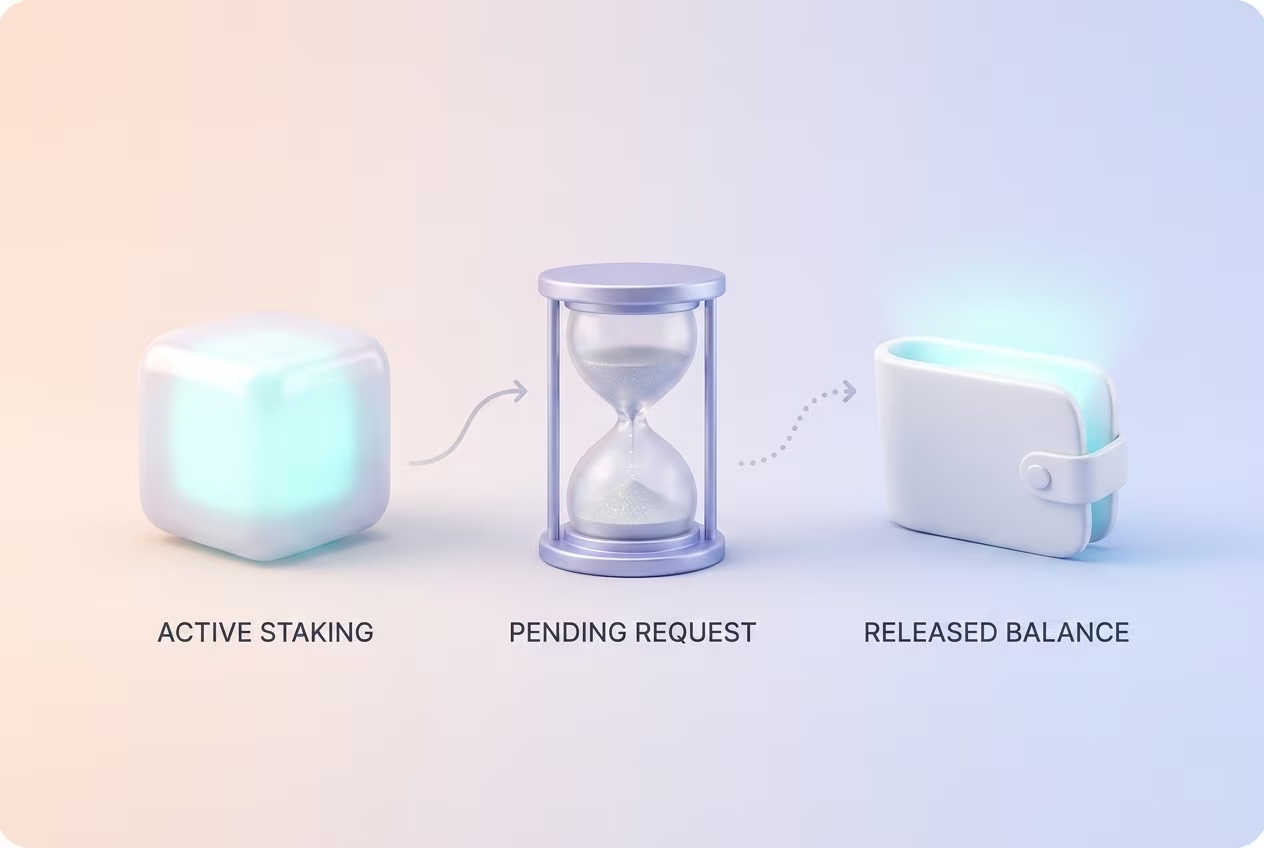
- Enter the unbonding period. Once the request is broadcast to the network, your assets enter a mandatory waiting phase known as the unbonding period. During this time, your tokens are no longer earning rewards, but they remain locked by the protocol to prevent malicious behavior. According to Kraken, these periods can range from a few days to several weeks depending on the network’s rules.
- Monitor the withdrawal queue. Some high-traffic networks, such as Ethereum, utilize a withdrawal queue. This means that even after the unbonding period ends, you may have to wait for the protocol to process your exit request based on the current volume of other users leaving the pool.
- Claim your tokens. On many networks, tokens do not automatically appear in your available balance once the waiting period expires. You may need to return to your wallet and perform a final «Withdraw» or «Claim» transaction to move the unlocked funds from the staking contract back into your main wallet address.
- Verify the transaction. Check your wallet balance and a blockchain explorer to ensure the tokens have been successfully transferred. Once the funds are in your main balance, they are fully liquid and can be traded, moved, or spent.
What Happens After You Submit an Unstake Request
When you submit an unstake request, your assets enter a transition phase known as the unbonding or cooldown period. During this time, your tokens are locked by the protocol, meaning you cannot trade or transfer them, and they typically stop earning rewards. The duration of this process is determined by the specific network’s security rules, exit queues, and epoch timings. While native protocols require these waiting periods to maintain network stability, services like Unstake.app now support over 80 staking assets, allowing you to bypass these delays and access your funds in just 5–10 minutes.
| Blockchain Network | Typical Waiting Period | Reward Status After Request | Key Factors Affecting Availability |
|---|---|---|---|
| Ethereum | 15–17 Days | Stopped | Exit queue length and withdrawal sweep processing. |
| Solana | 2–4 Days | Stopped | Completion of the current epoch. |
| Cosmos (ATOM) | 21 Days | Stopped | Fixed protocol-level unbonding timer. |
| Polkadot (DOT) | 28 Days | Stopped | Standard security cooldown for governance and slashing. |
Understanding the unbonding period by blockchain is essential for managing your liquidity, as these timelines vary significantly across the ecosystem.
Data Source: Kraken — Understanding Unbonding and Cooldown Periods
Why Your Staked Funds May Not Be Available Immediately
Hit «unstake» and expect your funds back immediately? That’s not how this works — every blockchain enforces its own lockup rules, and the wait can stretch from hours to nearly a month depending on where your assets are staked. These delays aren’t glitches. They’re deliberate protocol-level mechanisms baked into consensus design to protect network security, prevent validator manipulation, and keep economic incentives from collapsing overnight. Know the rules before you stake, not after.
The deepest source of delay is the native unbonding period — the lockup window hardcoded into each blockchain’s consensus rules. During this time, your tokens are frozen. No transfers, no selling, no using them as collateral. The timelines vary wildly: Ethereum’s exit queue can stretch from hours to several days depending on how many validators are racing for the door simultaneously, Cosmos-based chains lock you out for 21 days, Polkadot demands 28, and Solana ties cooldowns to epoch boundaries that typically resolve in 2–4 days. Before committing capital to any staking position, check the exact unbonding period by blockchain — the differences are significant enough to matter.
Then there’s the layer of unpredictability that network congestion and validator mechanics pile on top. On Ethereum, a parameter called the churn limit caps how many validators can exit per epoch. Market panic, a major protocol event, a coordinated exit — any of these trigger a queue, and your wait stretches well past the baseline. As Nadcab Labs points out, chain-specific exit mechanics can block immediate withdrawals in ways completely outside your control as a delegator. Worse, if the validator you delegated to gets jailed, tombstoned, or hit with a slashing event, your unbonding can be delayed further — and your principal might come back smaller than you sent it.
Centralized exchanges and custodial platforms stack yet another layer on top of all that. Many batch unstaking requests, run withdrawals on fixed internal schedules, or impose their own cooldown periods that have nothing to do with the underlying protocol. Your actual wait on an exchange can exceed what the chain itself requires. Some platforms quietly reserve the right to pause withdrawals during volatility spikes or liquidity crunches. The fix? Read the withdrawal terms before you stake — not when you need the money back. There’s a hard difference between what the protocol enforces and what the platform invents on top of it. That difference can cost you days.
The good news: platforms like Unstake.app support 80+ staking assets and let users access their funds in 5–10 minutes — without sitting through the native unbonding period at all. If liquidity matters to you, that changes the calculus entirely.
What Makes Unstaking Time Vary by Network
How long unstaking takes is almost entirely dictated by the specific network’s withdrawal rules — and those rules differ so dramatically across major proof-of-stake blockchains that comparing them feels like comparing a sprint to a prison sentence. Two core mechanics drive these differences: protocol-set unbonding durations and queue or rate-limit systems that throttle how quickly validators or delegators can exit. Know which mechanism your network uses, and you know exactly why your funds are locked — and for how long.
Ethereum handles validator exits through a rate-limited queue rather than a fixed timer. Submit a withdrawal request, and your exit gets batched with others, processed at a capped rate per epoch to protect the stability of the active validator set. Under normal conditions: roughly one day. During peak exit demand? That queue can stretch to several days or longer. Cosmos Hub takes the polar opposite approach — a strict 21-day unbonding period, hardcoded into the protocol. Once you submit an unbonding request for ATOM, your tokens are immediately non-transferable, stop earning rewards, and there is no queue to jump. You simply wait the full 21 days before your balance breathes again. Polkadot enforces a 28-day unbonding window for DOT, a parameter chosen as a deliberate security measure: it gives the network time to detect and respond to validator misbehavior before funds can move. As noted by Fensory, which provides a comparative overview of unbonding periods and withdrawal delays across Ethereum, Cosmos Hub, Polkadot, Solana, and NEAR, some networks rely on exit queues while others enforce fixed protocol timers — and that distinction fundamentally changes how predictable your wait will ever be.
Solana and NEAR sit at the shorter end of the spectrum. Solana carves time into epochs of roughly 2–3 days, and when you deactivate a stake account, your tokens stay locked until the current epoch closes and the next one begins. Your actual wait depends entirely on where you land in the epoch cycle at the moment you submit — a few hours, or nearly the full epoch length. For a detailed breakdown of how epoch timing affects your specific withdrawal window, see this guide on Solana epoch unbonding time. NEAR applies a similarly short fixed unbonding period of around 2–3 days, after which tokens automatically become transferable. No additional queue step. Done.
Across every one of these networks, one rule applies without exception: during any unbonding or cooldown period, your tokens earn nothing and go nowhere — even though they are no longer actively contributing to consensus. That is not a technical limitation. It is a deliberate protocol design choice, built to ensure that validators and delegators cannot exit instantly in response to an attack or slashing event, preserving network security at the cost of your liquidity. So before committing funds to staking on any chain, ask yourself three hard questions: does this network use a fixed timer or a dynamic queue, how far can the maximum wait realistically stretch, and does that liquidity trade-off actually fit your financial timeline?
Common Unstaking Delays by Chain and Platform
When you decide to unstake your assets, the time it takes to regain liquidity depends on the specific protocol’s unbonding rules and current network congestion. While some platforms offer instant access through internal liquidity management, native unstaking requires you to wait through a mandatory cooldown period. Below is a comparison of the native waiting times and primary delay factors for major blockchain networks as of 2026.
| Blockchain Network | Native Unbonding Period | Primary Delay Factors | Platform Differences |
|---|---|---|---|
| Ethereum (ETH) | 1–5+ Days | Validator exit queue and sweep cycles; can exceed 20 days during mass exits. | Custodial exchanges may add internal processing time to the exit queue. |
| Solana (SOL) | 2–3 Days | Epoch boundaries; wait time depends on when in the epoch you submit the request. | Flexible staking products may offer instant access via platform liquidity. |
| Polkadot (DOT) | 24–48 Hours | Reduced from 28 days following 2026 governance updates to the polkadot unstaking period. | Legacy 28-day periods may still apply on some older custodial interfaces. |
| Cosmos (ATOM) | 21 Days | Strict protocol-level lock; no rewards are earned during this unbonding window. | Native staking always requires the full 21-day wait regardless of wallet. |
| NEAR Protocol | 2–3 Days | Standard unbonding cooldown period before tokens become liquid. | Centralized platforms may impose additional security hold times. |
Data Source: Nadcab Labs — Understanding Blockchain Unbonding Periods and Exit Queues
If you need to bypass these native waiting periods, services like Unstake.app support over 80 staking assets and can provide access to your funds in just 5–10 minutes, effectively eliminating the standard unbonding delay.
Costs, Fees, and the Real Trade-Off of Waiting
Unstaking always has a price — and if you don’t calculate it before you pull the trigger, the market will calculate it for you. Withdrawal costs break into two hard categories: network gas fees and platform service fees. Gas goes straight to validators on the underlying blockchain to process your transaction. On Ethereum, that means a real slice of ETH, and the number swings with congestion. On Solana or Cosmos-based chains, gas is nearly invisible — fractions of a cent — but it’s still non-refundable. Succeed or fail, that fee is gone.
Service fees are a different animal entirely. Centralized exchanges and liquid staking protocols often clip a percentage of your staked amount or accumulated rewards the moment you submit an unstake request. The range is wild: zero on some platforms, up to 1% on others. Check the fee schedule before you click confirm — not after, because these charges execute at withdrawal and there’s no undo button. Some protocols also layer on a quiet exit penalty if validators are backed up in a queue. Not slashing. Just the cold arithmetic of a rushed exit during high demand.
The cost nobody talks about enough? Opportunity cost. It dwarfs every fee on this list. Most protocols stop accruing rewards the instant you submit your unstake request — and then you wait. A few days on lighter chains. Twenty-one days on Cosmos. Nine to forty-five days on Ethereum depending on how long the exit queue runs. That entire window, your capital sits exposed to price movement with zero yield to cushion the blow. Asset drops 10% during a 21-day unbonding period? No fee structure on earth makes that sting less. And if you unstake mid-bull-run to chase a short-term trade and the asset rips higher while you’re waiting — you just paid for that lesson in full.
So run the actual numbers. Gas fee plus service fee plus forfeited rewards during the waiting period plus raw price exposure. Add it all up. For a lot of holders, that math points toward one question: is there a faster path? Platforms like Unstake.app support 80+ staking assets and give users access to their funds in 5–10 minutes — no sitting through the native unbonding period, no weeks of dead capital. That kind of accelerated exit has its own fee structure worth examining, but when the alternative is a month of locked exposure, the comparison is worth making. Whatever you decide, base it on your real numbers. Not on assumptions. Not on hope.
Market Direction: Faster Access Is Becoming the Standard
Fast crypto unstaking stopped being a nice-to-have the moment real money started flowing into proof-of-stake networks at scale. Users once shrugged at multi-week unbonding periods — an annoying tax on participation, sure, but apparently worth paying. That shrug has disappeared. Retail stakers want out when they want out. Institutional desks absolutely demand it. And the entire staking infrastructure is reshaping itself around that pressure right now.
On-chain data makes the trend impossible to ignore. According to Crypto.news, Ethereum staking inflows began outpacing exits for the first time since mid-2025 — a clear sign that confidence in staking participation is bouncing back. Why? Because liquidity options have genuinely improved. When you know you can exit a position without sitting on your hands for three weeks, you are far more willing to stake in the first place. Liquidity and participation are not separate conversations. They are the same conversation.
The broader market has answered this demand with real structural changes. Liquid staking protocols now control a massive share of total value locked across major blockchains, offering tokenized representations of staked assets that keep working in other protocols while the underlying stake stays active. Platforms like Unstake.app — covering 80+ staking assets — exist precisely to close the gap between native unbonding timelines and what users actually need. Getting your funds back in 5–10 minutes instead of days or weeks? That is not a premium feature anymore. It is the baseline. Everything else gets measured against it.
For you as a staker, the practical implication is blunt: protocols and platforms that cannot offer competitive exit timelines are losing ground fast to those that can. Before you lock assets into any staking arrangement, evaluate not just the yield but the realistic timeline for retrieving your funds when market conditions turn. Fast unstaking options now exist across a growing number of networks. Knowing which tools support them — and exactly what they cost — is no longer optional research. It is the core of any informed staking decision worth making.
Can You Access Funds Faster Than the Native Unbonding Period?
Your staked funds aren’t locked forever — in fact, you can get them back in 5 to 10 minutes flat, no unbonding queue required. Every major blockchain bakes a mandatory waiting period directly into its protocol. Ethereum? Days, sometimes longer, depending on how backed up the validator exit queue gets. Cosmos chains enforce a brutal 21-day freeze. Polkadot makes you wait 28 days. Solana ties your exit to epoch boundaries, so timing matters. These aren’t bugs or oversights — they’re deliberate protocol mechanics. You cannot shortcut them through standard unstaking. Full stop.
But standard isn’t your only option. Platforms built around liquidity pools or peer-matching can effectively buy your staked position from you at near-market value, hand you liquid tokens almost immediately, and deal with the underlying unbonding process themselves. You’re not waiting for the protocol. You’re stepping out of line and letting someone else hold your spot. The cost? A fee — usually somewhere between 0.1% and 1%, depending on the asset and how deep the available liquidity runs. That’s the trade: you pay a small percentage to stop watching a countdown clock.
Unstake.app is built precisely for this. It covers 80+ staking assets across multiple blockchains, gets funds back to you in roughly 5 to 10 minutes, and removes the need to manage separate exit processes for every chain where you hold a position. That last part matters more than people realize — juggling Cosmos unbonding on one front while tracking a Polkadot exit on another gets messy fast. One platform, multiple chains, same fast turnaround. Worth noting, though: speed and availability depend on liquidity depth for each specific asset. Thin liquidity on a niche token means slower processing or a steeper fee.
So when does paying that fee actually make sense? Run the math honestly. On a large staked position, even 0.5% is real money — don’t wave it away. If your schedule has flexibility and markets aren’t moving against you, the native unbonding period costs nothing except time. But when liquidity matters right now — when a market move is happening, when you need capital urgently, when the fee is trivial relative to what you gain — skipping the queue is the rational call. Speed versus cost. That’s the whole decision, stripped down to its core.
If you need to unlock staked tokens immediately and gain liquid access to staked assets without waiting for the standard unbonding period, you can bypass the native withdrawal queue.
Questions to Check Before You Unstake
A two-minute checklist before you hit «unstake» can be the difference between smooth access to your funds and watching your capital sit locked for days you didn’t budget for. Every blockchain plays by its own rules — unbonding queues, withdrawal windows, reward claim mechanics — and assuming one network works like another is how people get burned. Verify the specifics for your asset first. Every time.
Start with the unbonding period. Ethereum validators navigate a queue-based exit system that can stretch from a few hours to several days when the network is congested. NEAR Protocol runs on its own mechanics entirely — the full breakdown lives in our guide on NEAR unbonding delay explained. Then check whether partial unstaking is even on the table. Some protocols force you out of your entire position at once. Others let you pull a specific amount while the rest keeps earning. That distinction matters enormously if you need liquidity without blowing up your whole staking setup. One more thing: pending rewards. Certain protocols will quietly forfeit unclaimed rewards the moment you exit without claiming first. Don’t let that be a surprise.
Two things catch people off guard more than anything else. First — transaction fees. Gas costs are not uniform. On Ethereum during peak congestion, unstaking can run several dollars. On Solana or Cosmos-based chains, you’re talking fractions of a cent. Always pull the current gas estimate before you confirm. Second — and this one stings — can you cancel an unstake request after submitting it? On most proof-of-stake networks, the answer is no. Once that unbonding request hits the chain, the protocol’s smart contract logic takes over and there’s no pulling it back. A handful of platforms do offer a narrow cancellation window, but treat that as a rare exception, not a safety net you can count on.
Worth knowing: if the native unbonding wait feels too long, Unstake.app supports 80+ staking assets and lets users access their funds in 5–10 minutes — no sitting through the full unbonding period. That kind of flexibility changes the calculus entirely for anyone managing active liquidity.
Last step: audit your staking method before you do anything. Staked through a centralized exchange? Their internal processing layers and withdrawal policies stack on top of whatever the native protocol requires. Used a non-custodial wallet or staking dashboard? Confirm the interface is still live and your wallet is pointed at the correct network. After you submit the unstake request, copy the transaction hash immediately. That hash lets you track unbonding status directly on a block explorer and gives you hard proof if you ever need to escalate to support. Do the checks before you initiate. Control the timeline — don’t react to it.
Conclusion
When you can actually get your staked crypto back depends on three things: the protocol’s own rules, the length of its exit queue right now, and how your platform handles the process on your behalf. No universal answer exists. Ethereum runs a validator exit queue that can stretch from a few hours to several weeks depending on how many validators are trying to leave at once. Cosmos-based chains lock you in for a fixed unbonding period — typically 21 days, no exceptions. Solana processes unstaking at epoch boundaries, which lands roughly every two to three days. Every protocol has its own logic. And that logic does not care about your timeline.
There’s another layer most people miss entirely. Some platforms automatically release your tokens the moment the unbonding period ends. Others just sit there, waiting for you to come back, find the claim button, and submit a separate transaction manually. Miss that step? Your tokens enter a kind of limbo — no longer earning rewards, but not yet spendable or transferable either. Find out which model your platform uses before you stake. Not after.
Beyond the standard unbonding window, several factors can push your wait even further. Heavy validator exit demand on Ethereum stretches the queue well past any baseline estimate. Network congestion slows on-chain confirmation of your withdrawal transaction. Exchange-based platforms often stack their own internal processing time on top of the protocol’s native period. Slashing events are rare — but they do happen, and they reduce what you actually receive. None of these are guaranteed. All of them are real. Any serious staker accounts for them when planning liquidity. That’s just due diligence.
Here’s where it gets interesting. Unstake.app supports 80+ staking assets and lets users access their funds in 5–10 minutes — without sitting through the native unbonding period at all. That changes the calculus significantly for anyone who needs liquidity on short notice.
The core trade-off in staking has never changed: yield versus liquidity. Lock your assets, earn rewards, accept that the money isn’t immediately yours. The question of when you can withdraw staked crypto doesn’t have a shortcut answer — it has a protocol-specific one. Check the unbonding period before you commit. Understand whether your platform demands a manual claim step. Build your timeline around facts, not assumptions. The decisions you make before staking are infinitely easier to manage than the surprises you discover halfway through a withdrawal.
Get help unstaking your crypto
Skip the native unbonding periods for 80+ assets and access your funds in just 5–10 minutes via Unstake.app.
Часто задаваемые вопросы
Can you unstake crypto at any time?
Yes, you can submit an unstake request at any time, but your funds will not be immediately available. Every proof-of-stake blockchain enforces a mandatory unbonding period after the request is submitted, during which your tokens are locked and cannot be traded or transferred.
What happens after you submit an unstake request?
Once your unstake request is broadcast to the network, your assets enter an unbonding period where they stop earning rewards and become temporarily frozen. Depending on the blockchain, this waiting phase can last anywhere from 2 days on Solana to 21 days on Cosmos or 28 days on Polkadot.
What factors can prevent immediate crypto withdrawals after unstaking?
Several factors can delay access to your funds: the native protocol’s unbonding period, validator exit queue congestion on networks like Ethereum, epoch boundary timing on Solana, and additional internal cooldown periods imposed by centralized exchanges on top of the blockchain’s own rules.
How can you unstake crypto without waiting for the unbonding period?
Platforms like Unstake.app support 80+ staking assets and allow users to access their funds in 5–10 minutes by using liquidity pools to bypass the native unbonding period entirely. A small service fee typically applies in exchange for this instant access.
Do you lose rewards when you unstake crypto?
Yes, most proof-of-stake protocols stop accruing staking rewards the moment you submit an unstake request. Your capital then sits exposed to price movement with zero yield for the entire duration of the unbonding period, which represents a significant opportunity cost on longer-lock networks like Cosmos or Polkadot.