
- Withdrawal Speed: 5–10 minutes via liquidity layers
- Supported Assets: 80+ staking tokens via Unstake.app
- Native Wait Times: 3 to 21 days (network dependent)
- Primary Risk: Liquidity trapping during market volatility
You can withdraw staked crypto by initiating an unbonding request through your wallet or using liquidity protocols to bypass network waiting periods. While native exits often require waiting days or weeks due to protocol rules, modern solutions like Unstake.app allow you to access funds from over 80 assets in just 5 to 10 minutes.
Standard Native Unstaking Process
When you decide to move your assets out of a staking protocol, you must follow a specific sequence of on-chain actions. Understanding how to unstake cryptocurrency step by step ensures you manage your liquidity expectations and avoid common errors during the waiting period.
- Initiate the Unstaking Request. You must access your wallet or staking dashboard and sign a transaction to «Unstake» or «Undelegate» your tokens. This action signals the protocol to stop generating rewards and begins the transition of your assets from a locked state to a liquid state.
- Wait Through the Unbonding Period. Most Proof-of-Stake networks enforce a mandatory cooldown or «unbonding» period, which can last anywhere from a few days to several weeks. During this time, your assets are typically not earning rewards and remain inaccessible while the network ensures security and prevents immediate mass exits.
- Monitor the Withdrawal Queue. In periods of high network congestion or protocol-specific exits (such as on Ethereum), you may face an additional withdrawal queue. This is a secondary waiting phase where the protocol processes exit requests in the order they were received.
- Claim Your Unlocked Tokens. Once the unbonding period and any applicable queues have finished, your tokens do not always appear in your wallet automatically. In many cases, you must return to the interface to «Claim» or «Withdraw» the now-liquid assets to complete the transfer to your available balance.
What Determines How Fast You Can Withdraw
When you decide to unstake your assets, the time it takes for funds to reach your wallet depends on several protocol-level and infrastructure factors. While the unbonding period explained by most networks serves as the baseline, additional variables like validator queues and manual claim requirements can extend the wait. Understanding these factors helps you plan your liquidity needs more effectively.
| Factor | Typical Impact | Description |
|---|---|---|
| Network Unbonding | 7 – 28 Days | The mandatory cooldown period set by the blockchain protocol to ensure network security. |
| Validator Exit Queue | Variable | A limit on how many validators can exit per epoch; delays increase during mass unstaking events. |
| Claim Requirements | Manual Action | Some protocols require a second «claim» transaction after the unbonding period ends to release funds. |
| Wallet/Platform Support | Software Dependent | Delays caused by exchange processing times or wallets requiring updates to support new withdrawal types. |
| Network Congestion | Minutes to Hours | High gas fees or saturated blocks can delay the confirmation of your unstaking or claim transactions. |
| Liquidity Routes | 5 – 10 Minutes | Using secondary markets or services like Unstake.app, which supports 80+ assets, to bypass native wait times. |
Why Some Withdrawals Take Days While Others Take Minutes
A withdrawal that settles in minutes versus one that drags on for weeks hinges on exactly three mechanics: the protocol’s native unbonding delay, validator exit queues, and how liquidity gets sourced to fulfill your request. Nail down each layer and you can predict — with real accuracy — how long your specific unstake will actually take. That nominal unbonding period in the protocol docs? Usually the most optimistic number you’ll ever see.
When you unstake directly through a proof-of-stake protocol, the crypto unbonding period only begins after your exit request gets accepted. And on many networks, that acceptance isn’t instant. Validator and protocol-level exit queues cap how much total stake can leave in a single block or epoch. Picture a market downturn: thousands of users hit withdraw simultaneously, your request joins a queue, and the native unbonding delay countdown doesn’t even start until you reach the front of that line. Real withdrawal times stretch well beyond what any documentation advertises. Then, once unbonding finally completes, you still need to submit a separate on-chain claim transaction to move the unlocked balance into your wallet — one more step, one more delay. As researchers at SSRN have documented, exit queue design and secondary liquidity conditions are the two primary variables driving actual withdrawal times — not the nominal unbonding window.
Immediate liquidity routes operate on an entirely different principle. Full stop. Instead of waiting through exit queues and unbonding timers, these routes tap off-chain or secondary-market liquidity: a pool or specialized service fronts you the liquid asset immediately, then redeems the underlying staked position through the slower native process on its own timeline. Your speed here depends on how deep the available liquidity runs and what pricing you’ll accept — slippage, discount rates, service fees. Liquidity abundant? Funds in minutes. Liquidity thin, demand spiking? The cost of immediate exit climbs fast, and in extreme cases the route collapses back toward native protocol timelines anyway. For a structured breakdown of how both paths compare across different networks, the proof of stake withdrawal guide covers the mechanics in practical detail. Platforms like Unstake.app support 80+ staking assets and let users access funds in 5–10 minutes by routing around the native unbonding period entirely — exactly this mechanism in action.
No single withdrawal timeline applies universally. That’s the blunt reality. A direct unstake on a network with a 21-day unbonding period and a congested exit queue could realistically take longer than 21 days. The same asset accessed through a liquid route with deep secondary-market liquidity could settle in under ten minutes. The trade-off never changes: faster access means accepting some form of fee, discount, or slippage, while waiting through the native process preserves full value but locks your capital for the duration. Know which mechanism your chosen method actually uses — and check current queue depth before you initiate — and you’ll have a realistic picture of what to expect before you commit to any withdrawal path.
Fast Access Options Beyond Native Unbonding
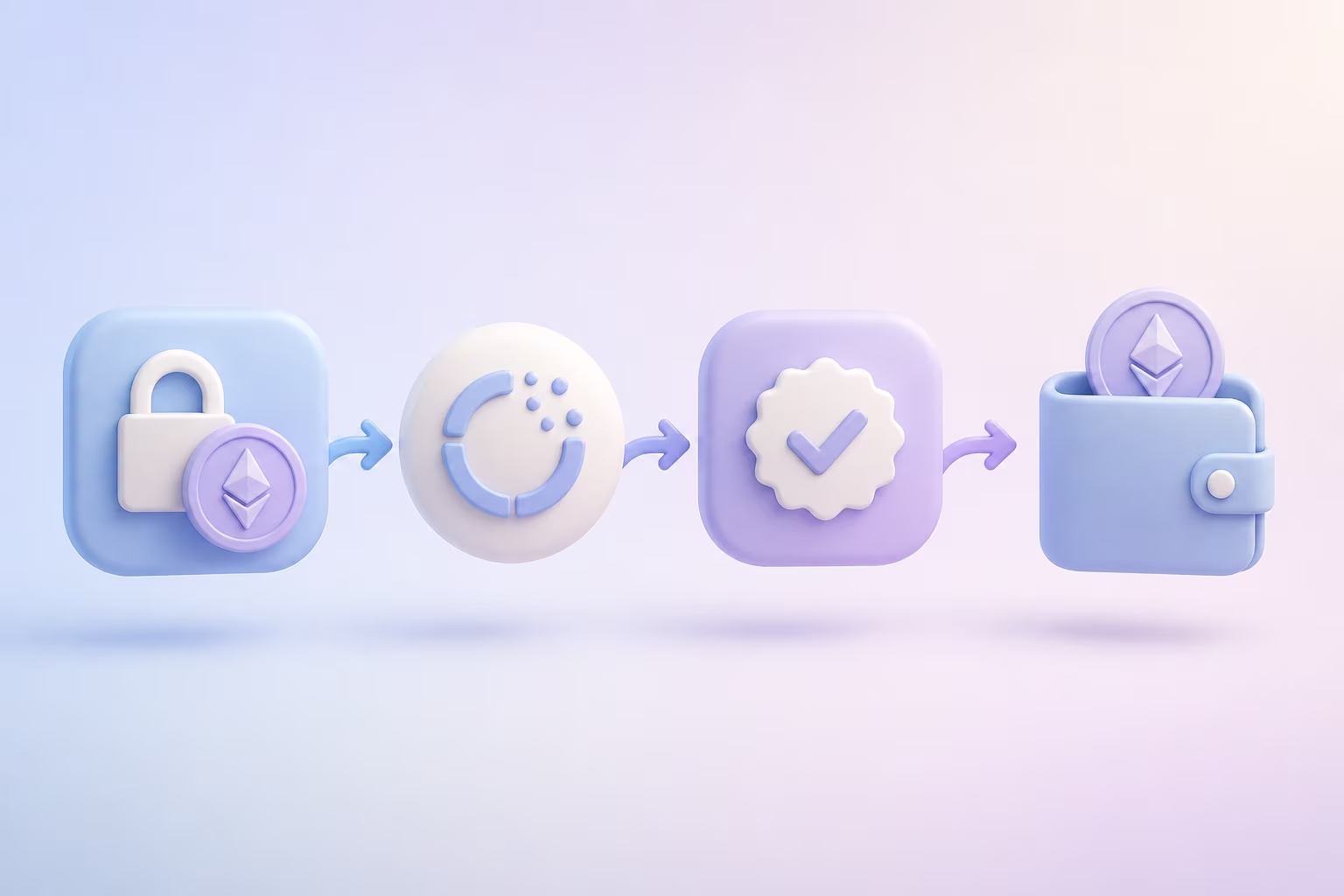
When the native unbonding queue stretches into days or weeks, you have real alternatives — and some of them get you out in minutes. The most battle-tested route is liquid staking, where you hold a derivative token — stETH on Ethereum, mSOL on Solana — that represents your position in the protocol. These tokens trade freely on decentralized exchanges. Swap them. Done. No unbonding trigger, no waiting room. The catch? Swap price moves with market liquidity, so during a stress event you might walk away with slightly less than face value. That’s the cost of speed.
The second route is smarter for larger positions. Platforms that aggregate liquidity across 80+ staking assets — covering all the major proof-of-stake networks — can route your exit request against live liquidity pools and get the whole thing settled in 5 to 10 minutes flat. No waiting days. No waiting weeks. The platform absorbs the unbonding delay on its end, sourcing funds from reserves or from users who happen to be entering positions at the same moment you’re leaving. Staking withdrawal rules vary by service, so check fee structures, minimum amounts, and payout conditions before you commit. Unstake.app is one example of this kind of aggregator — 80+ supported assets, exits processed in that 5–10 minute window without touching the native unbonding period at all.
Third option: secondary market sales. Some protocols issue staking receipts — non-fungible or semi-fungible — that you can list and sell directly to a buyer willing to wait out the remaining lock in exchange for a discount. Less liquid than a token swap. Less common, too. But when swap pools run shallow, it works. The discount you accept reflects the time value of whatever lock period remains, so the closer you are to the natural release date, the less you have to give up. Simple math, real money.
Every one of these paths carries a cost — swap fee, service fee, or a haircut on face value — that simply doesn’t exist if you wait out the native schedule. Which option wins? That depends on three things: how urgently you need the liquidity, how your position size stacks up against available pool depth, and whether the fee actually makes sense given your circumstances. The investors who think through their exit strategy before they stake are the ones who never get caught flat-footed when they need out fast.
Native Withdrawal vs Fast Liquidity Route
When you decide to exit a staking position, you generally face two paths: the native protocol route or a fast liquidity service. Native unstaking is governed by blockchain-specific rules, often requiring a mandatory unbonding period where your assets are locked and non-earning. Alternatively, tools like Unstake.app allow you to skip unbonding periods by providing immediate liquidity for over 80 supported assets. Understanding these differences is essential for any crypto staking withdrawal guide, as the choice impacts your ability to react to market volatility.
| Feature | Native Unstaking | Unstake.app (Fast Route) |
|---|---|---|
| Timeline | Days to Weeks | 5 to 10 minutes |
| Waiting Period | Mandatory Unbonding | None (Instant Exit) |
| Claim Steps | Multi-step (Deactivate + Claim) | Single Transaction |
| Liquidity Access | Only after cooldown | Near-instant |
| Supported Assets | Per-chain specific | 80+ Staking Assets |
| Typical Use Case | Long-term exit | Urgent cash / Active trading |
Data Source: Cryptoscope Blog — Explains native unstaking timelines and fast liquidity contrasts
If you need to bypass long unbonding periods and unlock your staked tokens immediately, there are specialized tools designed to provide early access to your liquidity.
Costs, Fees, and Opportunity Cost
Withdrawing staked crypto costs more than one line on a receipt — gas fees, protocol spreads, and the yield bleeding out while your tokens sit locked in an unbonding queue all hit your bottom line at once. Break down each layer before you move, and the decision between a fast exit and a patient wait suddenly becomes a lot clearer.
Gas fees are the most visible cut. On Ethereum, a single withdrawal transaction can run anywhere from $1 to $15 depending on how congested the network is. Solana and Cosmos chains? Fractions of a cent. If you are pulling out a small position, gas alone can swallow a painful chunk of everything you earned. Then there is the spread. Liquid staking protocols often apply an exit fee or embed a markup in the exchange rate when you swap a liquid staking token back to the base asset. Under normal conditions that spread hovers near zero — but when redemption queues back up and secondary market liquidity dries out, it can jump to 0.5–1% or worse. Always check the live exchange rate between your liquid token and the underlying asset before you confirm anything. That «simple swap» might not be so simple.
The cost nobody talks about enough is opportunity cost — the yield you stop earning the moment your tokens enter an unbonding queue. Ethereum’s withdrawal line can stretch from a few hours to several days during high-exit periods. Cosmos-based chains lock you out for 21 days, no exceptions. Your tokens earn exactly nothing during that window. Run the math: at an 8% annualized yield, a 21-day unbonding period quietly drains roughly 0.46% of your principal. On a large position, that is real money. Our proof of stake withdrawal guide walks through how to calculate this across different chains and setups before you pull the trigger.
So when does paying for speed actually make sense? When token prices are moving hard and a multi-day wait carries more downside risk than the exit fee itself. When you need liquidity for something time-sensitive. When the gas premium for a faster path is small relative to your position size. It makes far less sense when you are withdrawing modest rewards on a low-fee chain, or when markets are calm and the unbonding window is short. The rule is blunt: add up the full cost of a fast exit — gas, spread, protocol fee — and stack it against the yield you would have earned by staying put. If the fee beats the forgone yield and you have no urgent reason to move, waiting wins. Almost every time.
Regulatory Direction in the United States
U.S. regulators have drawn a hard line between managed staking services and software tools that put users in direct control of their own blockchain interactions. That line has real consequences for anyone navigating wallet staking withdrawal or on-chain unstaking — it determines who operates under securities oversight and who doesn’t. Managed staking services, where a company holds your assets, runs the validator keys, and cuts your reward checks, have absorbed the heaviest regulatory heat. The SEC has argued repeatedly that these arrangements can qualify as investment contracts under the Howey test. And honestly? Looking at the structure, it’s not hard to see why.
Non-custodial software tools sit in a fundamentally different position. When you fire up a wallet interface and trigger on-chain unstaking yourself, your private keys never leave your hands. No intermediary touches your funds. No third party decides when you exit or how much you earn. Regulators have moved considerably more slowly when it comes to applying securities frameworks to this category — and for good reason. You’re interacting with open-source code, not betting on someone else’s management skills. As Figment Insights has noted, the institutional consensus is increasingly moving toward treating non-custodial staking infrastructure as its own distinct category, separate from managed services — especially as policymakers push to write clearer rules for the entire space.
The practical read on all this? Your regulatory risk profile hinges almost entirely on how custody gets structured. Delegate to a validator through your own wallet, trigger wallet staking withdrawal directly on-chain — you’re engaging with the protocol in a way regulators have been slow to classify as a securities activity. Deposit assets into a platform that manages staking on your behalf, pools rewards, and controls your exit window — that looks much closer to what enforcement actions have actually targeted. Neither category is fully settled under current U.S. law. Congress is still working toward comprehensive digital asset legislation, and the ground keeps shifting.
For anyone focused on on-chain unstaking, the core takeaway is blunt: self-custody and direct protocol interaction remain the cleanest legal path under the current U.S. framework. That doesn’t make you bulletproof. Protocol-level rules, validator behavior, and withdrawal queue mechanics still apply regardless of how regulators classify your activity. But it does mean you’re far less likely to wake up to frozen assets or a service provider facing an enforcement action right in the middle of your withdrawal. Watch the regulatory developments. U.S. rules are expected to sharpen considerably through 2026 and beyond — and that affects every staker, not just the institutional ones.
Main Risks When Trying to Withdraw Staked Assets
Pulling staked assets out isn’t just a waiting game — it’s a minefield of protocol mechanics, validator behavior, and user-side errors that can cost you real money if you go in blind. The first wall most people hit is the mandatory unbonding period baked into proof-of-stake protocols. Your tokens are frozen. No transfers. No selling. No collateral. And that’s before you factor in exit queues — because when everyone rushes for the door at once, the stated unbonding time becomes a floor, not a ceiling. Ethereum’s validator exit queue has stretched waits from days into weeks during high-demand periods. The protocol didn’t change. The crowd did.
Slashing deserves more respect than it gets. This risk doesn’t pause while your funds are unbonding — it runs the entire time your tokens are delegated. If the validator you chose double-signs a block, goes dark for too long, or breaks protocol rules, the network cuts a portion of your stake as a penalty. Gone. As CherryServers documents, slashing and downtime penalties rank among the most direct financial threats in staking, especially when users delegate to smaller, unproven validators without ever checking their track record. Then there’s custodial risk — the part people forget until it’s too late. Stake through a centralized exchange or third-party platform and you don’t hold your keys. A hack, an insolvency event, or a unilateral policy shift can lock you out completely, regardless of what the underlying blockchain would otherwise allow.
Liquidity risk is the slow bleed underneath all of this. While your tokens sit locked in staking or crawl through an unbonding queue, the market moves without you. A sharp drawdown during a 21-day Cosmos unbonding window, or across a multi-week Ethereum exit queue, leaves you fully exposed with zero ability to respond. That’s why reviewing staking withdrawal rules for each specific protocol before you commit funds isn’t optional — it’s the job. Lockup durations vary wildly across chains. Queue mechanics differ. Reward claim structures don’t follow a universal template. Assuming they do is a mistake that keeps showing up in loss reports.
User errors at the claim stage account for a surprisingly large share of lost or delayed funds. Most protocols won’t automatically return your tokens when unbonding ends — you have to manually trigger a claim transaction. Skip that step and your funds sit in a released-but-unclaimed limbo, sometimes for weeks, sometimes indefinitely. Other common failures: sending withdrawn assets to the wrong network address, mixing up a token’s native chain with a bridged version, misreading which transactions release rewards versus principal. Before you attempt any withdrawal, nail down the exact steps your wallet or platform requires, double-check the destination address and network, and confirm whether rewards and principal require separate claim actions. These details shift by protocol. The verification step isn’t bureaucracy — it’s the last line between your funds and a permanent mistake.
What U.S. Users Should Know Before They Withdraw
The platform you staked through can determine whether you ever see your crypto again — and for U.S. users, that’s not hyperbole. America’s regulatory environment for crypto services is aggressive, evolving, and unforgiving to platforms that misstep. The structure of your staking setup — centralized exchange, custodial service, or self-custody protocol — directly shapes your withdrawal eligibility, your legal protections, and your practical ability to move funds when you actually need them.
Centralized platforms that manage staking on your behalf run on a custody model. They hold your private keys. Full stop. That means your ability to withdraw hinges entirely on the platform’s operational health, its regulatory compliance, and whether it’s currently under enforcement pressure. The U.S. Securities and Exchange Commission has already moved against managed staking programs offered by centralized providers, treating them as potential unregistered securities offerings. That classification isn’t abstract — it can trigger service suspensions, asset freezes, or forced shutdowns that lock users out of their own funds. None of that has anything to do with the blockchain itself. It’s purely a company problem that becomes your problem.
Self-custody staking works differently. Your keys stay in your wallet. No third party touches your assets. When you stake directly through a protocol or use a non-custodial interface, your withdrawal eligibility follows on-chain rules — unbonding periods, validator queue mechanics, network-level logic — not a company’s compliance calendar or a lawyer’s cease-and-desist letter. For U.S. users who want predictable, uninterrupted access to staked assets, this distinction isn’t just technical. It’s the whole ballgame. Protocol-level risks still exist: slashing, smart contract bugs, network congestion. Real risks. But you’ve eliminated the counterparty layer — the part where a centralized intermediary’s business decisions become your financial emergency.
Before you attempt any withdrawal, confirm three things. Who holds your private keys right now? What’s the platform’s current regulatory standing with U.S. authorities? And does the platform’s terms of service contain any withdrawal restrictions buried in the fine print? If you staked through a centralized exchange, check whether it has received regulatory notices or voluntarily pulled staking services for U.S. residents — several major platforms have done exactly that in recent years, quietly and without much warning. If you staked through a self-custody wallet connected directly to a protocol, your path is cleaner: governed by on-chain rules that are transparent, auditable, and immune to corporate policy reversals. Know which situation you’re in before you click anything.
Conclusion
Your staked crypto isn’t locked forever — but getting it back fast requires knowing exactly which rules your protocol plays by, and whether a smarter exit route exists. No two blockchains handle withdrawals the same way. Ethereum runs a validator exit queue that can stretch anywhere from a few hours to several days depending on how congested the network gets. Cosmos chains impose a hard 21-day unbonding window — no exceptions, no shortcuts at the protocol level. Solana processes unstaking at epoch boundaries, which typically means a two-to-three day wait. Know your asset. Know its rules. That’s step one.
When time matters, liquidity-based platforms change the equation entirely. Instead of sitting out a native unbonding period, you swap your staked position for liquid tokens almost immediately. Unstake.app covers 80+ staking assets and gets funds back to users in 5–10 minutes — no waiting, no queue, no protocol delay. The trade-off is honest: you may receive slightly less than face value depending on market depth at the moment you exit. But here’s the real question — is a small slippage cost worth days of locked capital? For most users in most situations, the answer is yes.
Several forces consistently determine how long and how expensive any withdrawal will be. First, the blockchain’s own unbonding design — this is non-negotiable at the base layer. Second, the size of your position relative to available exit liquidity. Third, current validator queue depth on proof-of-stake networks. Fourth — and this one catches people off guard — whether the platform you originally staked through adds its own processing layer on top of the base protocol. Two platforms, same asset, noticeably different wait times. It happens more than people expect. For a full breakdown of the withdrawal workflow across major networks, the crypto staking withdrawal guide walks through every step and tells you what to verify before you even click unstake.
Here’s the core truth: staking locks your capital temporarily, not permanently. But every blockchain makes a deliberate architectural choice between security, decentralization, and liquidity access — and withdrawal timing is the direct, unavoidable consequence of that choice. Your job as a staker is to understand those trade-offs before committing funds, not in the panicked moment when you suddenly need them back. Check the protocol docs. Check current queue conditions. Then choose the withdrawal path that fits your actual timeline — not just the one that looks fastest on a marketing page.
Get help unstaking your crypto
Skip the native unbonding periods for over 80+ assets and access your funds in just 5–10 minutes.
Часто задаваемые вопросы
What steps are required to withdraw staked cryptocurrency?
You must initiate an unstaking request through your wallet or staking dashboard, wait through the protocol’s mandatory unbonding period, monitor any validator exit queue, and then manually submit a claim transaction to transfer the unlocked tokens to your available balance. Some protocols require all four steps; others combine the last two.
How long does it take to unstake crypto and receive funds?
Native unbonding periods range from roughly 2 days on Solana to 21 days on Cosmos-based chains, with Ethereum varying based on validator exit queue depth. Fast liquidity platforms like Unstake.app bypass the native wait entirely and deliver funds in 5–10 minutes by routing your exit through secondary liquidity pools.
What factors affect how quickly a staked crypto withdrawal is processed?
The primary factors are the blockchain’s built-in unbonding period, the current depth of the validator exit queue, whether a manual claim transaction is required after unbonding ends, network congestion affecting gas confirmation times, and the liquidity depth available if you use a fast-exit route instead of the native protocol path.
What are the main risks when withdrawing staked cryptocurrency?
Key risks include liquidity trapping during market downturns when your capital is locked in an unbonding queue, slashing penalties that can reduce your principal if a validator misbehaves before your exit completes, custodial platform failures that can freeze withdrawals entirely, and user-side errors such as missing the manual claim step or sending assets to the wrong network address.
How does Unstake.app allow users to skip the unbonding period?
Unstake.app routes your exit request against pre-funded liquidity pools rather than waiting for the native protocol to process the unbonding cycle. It supports 80+ staking assets and settles withdrawals in approximately 5–10 minutes by fronting the liquid asset immediately while the platform handles the slower on-chain redemption on its own timeline.