- Fee Recipient: Decentralized miners and validators
- Calculation Basis: Network demand and transaction data weight
- Fee Tiers: Lower, Typical, and Higher priority options
- Key Requirement: Native asset balance (e.g., ETH for gas)
A Jaxx Liberty transaction fee is a mandatory payment sent to blockchain validators to process your transfer, not a service charge kept by the wallet. These decentralized costs fluctuate based on real-time network congestion, the data size of your transaction, and the specific blockchain protocol you are using to move your digital assets securely.
How network fees differ by asset type
Understanding how different blockchains calculate costs is essential for managing your digital assets effectively. In Jaxx Liberty, we provide you with the tools to review these costs before you confirm any transaction, ensuring you maintain full control over your self-custody experience. Whether you are dealing with Jaxx Liberty gas fees or Bitcoin miner incentives, the logic depends entirely on the underlying network architecture.
| Asset Type | Fee Calculation Model | Payment Asset | Common User Mistake |
|---|---|---|---|
| Bitcoin (UTXO) | sat/vB × Transaction Size | BTC | Ignoring network congestion levels |
| Ethereum (EVM) | gasUsed × (baseFee + priorityFee) | ETH | Insufficient ETH for gas coverage |
| ERC20 Tokens | Contract Call Gas Units × Price | ETH | Expecting to pay fees in the token itself |
Why network fees change before you hit confirm
Blockchain networks price block space in real time — and the fee estimate you see in Jaxx Liberty is a live snapshot of that market, not a fixed number someone chose for you. Every transaction you broadcast competes with thousands of others for a slot in the next block. Miners and validators pick the highest bidders first. So when demand spikes — a token launch, a wave of DeFi activity, a market volatility event — the cost to get confirmed quickly spikes with it. That’s not a wallet policy. That’s just how public blockchains work.
Think of the mempool as a waiting room that never closes. Unconfirmed transactions pile in, and when that room gets crowded, fees climb because users start outbidding each other for limited block space. On Ethereum, the gas market handles this automatically: base fees recalibrate every single block based on how full the previous one was, while priority fees let you essentially tip validators to move faster. On Bitcoin, the competitive logic runs through satoshis per byte. As Fidelity Digital Assets explains, fee volatility tracks directly with network congestion and block space demand — meaning the exact same transfer can cost dramatically different amounts depending purely on when you hit send.
This is why the fee shown in Jaxx Liberty can shift between the moment you type in a recipient address and the moment you tap confirm. The wallet queries live network conditions and recalculates its recommendation in near real time. Pause on the confirmation screen while traffic surges? The suggested fee may tick upward to keep your transaction competitive. You can always choose a lower fee — but that’s a conscious tradeoff. Lower fee means your transaction waits longer in the mempool, and if congestion is severe, it may stall and require a blockchain congestion delay fix. Knowing why fees move the way they do turns that decision from a surprise into a strategy.
Where this gets genuinely critical: when your available balance is tight. If the fee rises after you’ve entered the transfer amount, your wallet may no longer have enough to cover both the send and the updated fee — and the transaction fails before it ever touches the network. The fix is simple but easy to overlook. Always keep a small buffer in the native asset of whatever chain you’re using: ETH for Ethereum and ERC-20 tokens, BTC for Bitcoin transfers, and so on for every other network. And always review the fee estimate on the confirmation screen — not just the send amount. That one habit, consistently applied, separates users who get surprised by failed transactions from those who never do.
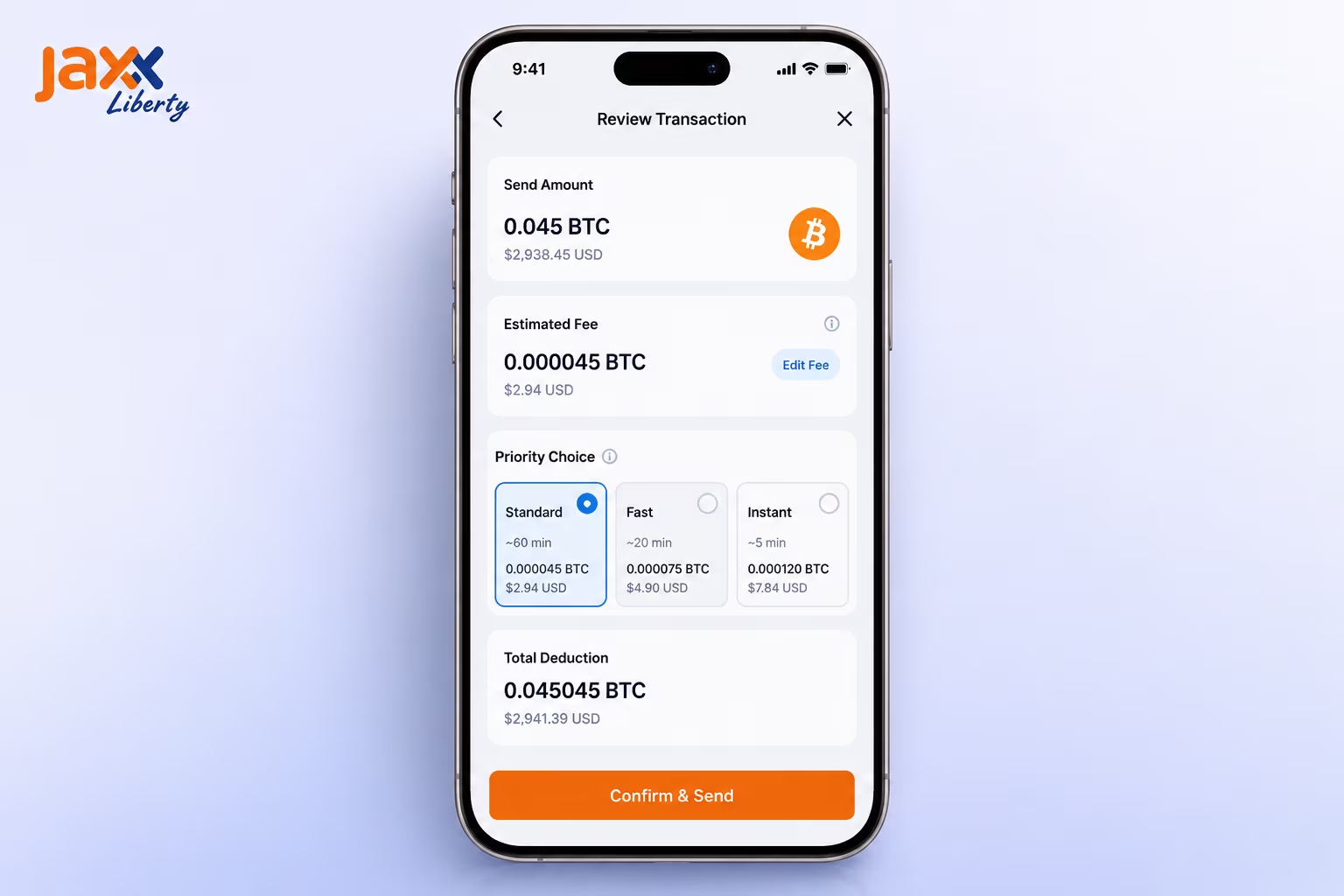
How to review the fee before confirming a crypto transfer
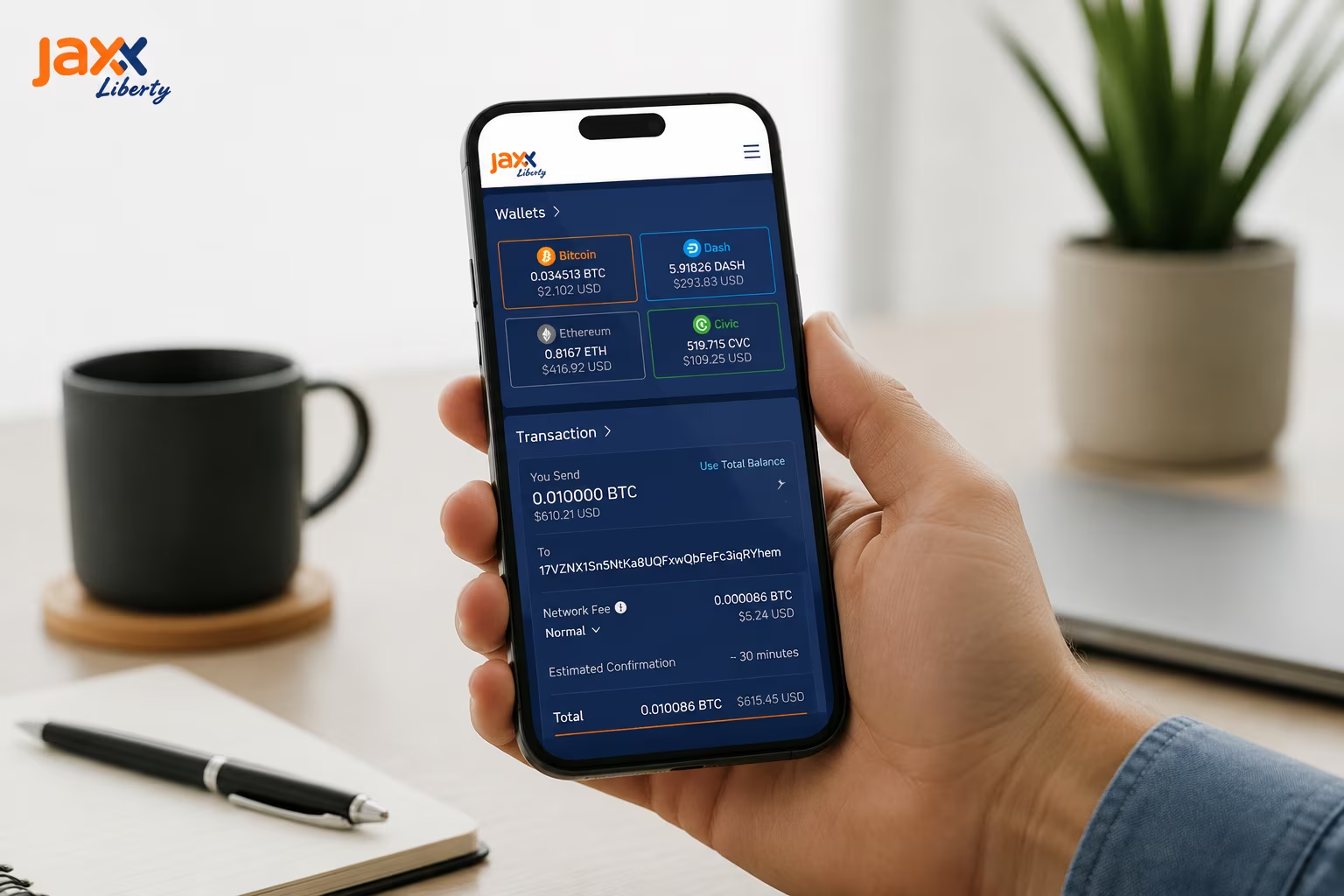
Before you finalize any transaction in Jaxx Liberty, it is essential to verify the details on the confirmation screen. This ensures your funds reach the correct destination and that you are comfortable with the network costs associated with the current blockchain environment. For a deeper understanding of how these costs are calculated, you can refer to our crypto network fee guide.
- Verify the recipient address. Double-check every character of the destination address to prevent sending funds to an incorrect or malicious wallet, as blockchain transactions cannot be reversed.
- Confirm the selected asset. Ensure you are sending the correct cryptocurrency (e.g., BTC, ETH, or LTC) from the appropriate digital wallet within your portfolio.
- Check the fee estimate. Review the network fee generated by the blockchain; this amount goes to miners or validators to process your request and is not collected by Jaxx Liberty.
- Select your speed tier. Choose between different priority levels (e.g., Slow, Average, or Fast) based on how quickly you need the transaction to be confirmed on the network.
- Calculate the total deduction. Look at the combined sum of the asset amount and the network fee to understand exactly how much will be removed from your wallet balance.
- Review the remaining balance. Ensure that after the transfer and the fee are deducted, you still have sufficient funds for future operations, especially if you are managing gas-heavy assets like Ethereum.
When a low fee can cause delays or failed sending attempts
Picking a fee that’s too low during peak network traffic is the single fastest way to get your transaction stuck — sometimes for hours, sometimes for days. The moment you submit a transfer from Jaxx Liberty, that transaction drops into the mempool: a shared holding area spanning the entire blockchain network. Miners on Bitcoin, validators on Ethereum — they all sort that queue by fee priority. Your transaction sits too cheap? It waits. And during serious congestion, «waiting» isn’t a minor inconvenience — your funds are effectively frozen with zero confirmed outcome on the horizon.
The gap between a slow and a fast transaction fee isn’t just about patience. It’s real financial exposure. A transaction priced below what the network demands can hang pending indefinitely — and some networks will eventually purge it from the mempool entirely, forcing a full resubmission at a higher fee. Here’s where it gets painful: if your balance is tight and network fees have climbed since you first hit send, you might not have enough left to cover that higher fee on the second attempt. As BitGo confirms, underpriced transactions get consistently deprioritized regardless of how long they’ve been sitting in the queue — the mempool doesn’t reward loyalty, only fees.
A stuck transaction creates a chain of opportunity costs most users never see coming. Your funds aren’t lost. But they’re locked — untradeable, unmovable, inaccessible — until the transaction either confirms or gets dropped. In a fast-moving market, that window can hurt badly. Jaxx Liberty surfaces fee options clearly before you confirm any transfer, giving you a real look at current network conditions and the ability to pick a tier that actually matches your urgency. Already dealing with a stuck send right now? The blockchain congestion delay fix guide covers the exact steps to resolve it.
The smartest habit you can build: always check the estimated confirmation time shown next to each fee option before tapping confirm. During high-traffic windows — major market moves, NFT launches, protocol upgrades — even the so-called «standard» fee tier can behave like a bargain-basement tier because the entire mempool floor shifts upward fast. Choosing a fee that reflects real-time network demand isn’t an optional detail you can skip. It’s a core part of sending crypto responsibly from any self-custody wallet. You control that decision. Understanding what each fee tier actually means for your transaction is what keeps you from learning this lesson the hard way.
Expert takeaway on keeping a gas buffer
No gas reserve, no transfer — it’s that simple, and every failed send in crypto history traces back to this one overlooked detail. Every time you move an ERC20 token or any asset riding on a native coin’s rails, your wallet demands two things simultaneously: the token amount itself, and a separate pocket of the native coin to pay the network. Miss that second piece, and the transaction dies on the spot — no matter how fat your token balance looks. This isn’t a Jaxx Liberty quirk. It’s how every public blockchain is wired, full stop. Understanding it means you stop hitting walls at the worst possible moment.
Fee spikes don’t announce themselves. High trading volume, a hot NFT mint, some protocol event nobody saw coming — and suddenly gas prices are three times what they were an hour ago. So stop thinking about your fee reserve as a fixed number. It’s a living buffer that needs to breathe with the market. For Ethereum-based assets, 0.01–0.02 ETH above your intended spend gives you room during calm conditions. During peak congestion? That margin can evaporate fast. For ERC20 gas fee planning, the rule never changes: treat your native coin balance as a dedicated operational fund. Not spare change. Not a rounding error. A fund.
One of the most common reasons a transfer stalls inside Jaxx Liberty Wallet comes down to this exact gap. When you hit send, the wallet reads live network conditions, calculates the estimated fee, and immediately checks whether your native coin balance can cover it. If it can’t, nothing moves. That’s protective behavior, not a bug — broadcasting an underfunded transaction wastes your time and, on certain networks, can still bleed a partial fee without ever completing the send. The confirmation screen shows you the live fee estimate before you approve anything. Read that number. It’s not decorative.
The fix is boring, which is exactly why it works: make checking your native coin balance a reflex before every transfer. Thin on ETH before moving tokens? Top it up first, then send. Jaxx Liberty puts fee information right in front of you at the confirmation step — full visibility, no guessing. Self-custody hands you every decision, and keeping enough gas in reserve is the cheapest, highest-leverage habit you can build. Markets move. Fees spike. Your reserve shouldn’t be the thing that catches you off guard.
Before planning your next transfer, we recommend connecting your wallet to review the full list of supported assets and current network fee requirements for each blockchain.
Common fee issues and what to check first
Understanding how Jaxx Liberty network fees work is essential for ensuring your transactions are processed quickly and without errors. When you send digital assets, the blockchain requires a fee to compensate miners or validators; if your wallet balance doesn’t cover both the transfer amount and these dynamic costs, the transaction will fail.
| Common Problem | Likely Cause | First Check / Action |
|---|---|---|
| Insufficient Native Coin | Missing Gas/Miner Fee | Ensure you have enough of the native asset (e.g., ETH for tokens, BTC for Bitcoin) to cover fees beyond the send amount. |
| «Send All» Error | Manual Entry Conflict | Use the built-in «Send All» function to automatically deduct fees, or manually leave a small buffer in your balance. |
| Estimation Failure | Network Congestion | Increase the gas price to medium/high in settings or wait for lower network activity before retrying. |
| Transaction Rejected | Dynamic Fee Change | Verify the total amount + network fee before confirming; adjust custom fees via the gear icon if necessary. |
Why tokens still need a native coin balance
Your token balance means nothing if you have no native coin left to move it — every transfer, swap, or contract call burns the network’s base asset, full stop. This trips up more multi-asset holders than almost anything else in Jaxx Liberty. You’re sitting on a stack of ERC-20 tokens, you go to send them, and the transaction bounces. Not because anything is wrong with the tokens. Because Ethereum needs ETH to process the move — and your ETH wallet is dry. The token balance and the gas balance live in completely separate buckets. The network does not care how much you hold. No ETH, no movement.
This is not a quirk or an oversight. It reflects the fundamental architecture of how blockchains work. Every network runs on a single native coin that validators accept as payment for computation. ETH on Ethereum. BNB on BNB Smart Chain. MATIC on Polygon. When you push a token transfer, the network prices that operation in the native asset — never in the token itself. As Fidelity Digital Assets breaks down in their Ethereum fee analysis, the ETH required fluctuates with network congestion and the raw computational weight of the operation. A basic token send costs less than a complex smart contract call. But both demand ETH before anything moves.
So before you confirm any transfer in Jaxx Liberty, check your native coin balance first. Not after. The wallet surfaces an estimated network fee right before you approve — that number is your signal. Ignore it and you risk a failed transaction that still chews through a small slice of ETH with nothing to show for it. For a deeper look at keeping the right ETH cushion relative to your token activity, the guide on ERC20 gas fee planning walks through exactly that, including how to size your reserve against congestion spikes.
Jaxx Liberty surfaces fee estimates because in self-custody, the responsibility lands entirely on you. No intermediary catches a failed transaction. No system quietly tops up your gas balance. The habit is simple: keep a small reserve of the native coin on every chain where you hold tokens — ETH on Ethereum, BNB on BNB Smart Chain, and so on down the list. Treat that reserve as infrastructure, not an afterthought. Before every send, confirm the native coin balance clears the current fee with room to spare. That margin is what separates a smooth transfer from a frustrating, costly failure.
US tax treatment of crypto transfer fees
How a crypto sending fee gets taxed comes down to one thing: did ownership change, or didn’t it? Moving cryptocurrency from an exchange into your Jaxx Liberty wallet — same person, different address — isn’t a disposal. The IRS sees no taxable event there. You’re not selling, not swapping, not acquiring something new. You’re just relocating what’s already yours. But here’s the catch: the network fee you paid to complete that move still belongs in your records, because depending on how you account for it, it can quietly shift your cost basis.
Tie a fee to an actual taxable event, though, and the math gets more interesting. A sending fee paid at the moment you buy crypto can typically be folded into your cost basis — raising the amount you’re considered to have paid for the asset. A fee paid when you sell or swap can usually be deducted from your proceeds, trimming your taxable gain. That’s not a loophole. That’s how it works. According to the IRS Official Website, fees connected to the acquisition or disposition of a digital asset directly affect the cost basis and proceeds figures used to calculate capital gains or losses.
For a straight wallet-to-wallet transfer where ownership never changes hands, the network fee generally won’t stand alone as a deductible expense for individual taxpayers — and it won’t generate a capital gain or loss by itself. None of that means you should ignore it. Record every fee: the asset, the amount, the date, the network. When you eventually sell or exchange that asset, your tax professional needs the complete picture to get the numbers right. Jaxx Liberty covers a wide range of assets — Bitcoin, Ethereum, Litecoin, and more — and each one carries its own fee structure. Track costs per asset, per transaction. No shortcuts.
Before you confirm any transfer in Jaxx Liberty, glance at the displayed network fee and ask yourself one question: does this transaction involve a change in ownership, or is it a self-custody move? The answer shapes everything. Fee mechanics vary sharply by blockchain — Ethereum runs on gas-based pricing that swings hard with network congestion, while Bitcoin calculates fees per byte based on transaction size and mempool pressure. Always make sure your wallet balance covers not just the amount you’re sending, but the network fee on top of it. Running short on fee coverage means the transaction won’t go through, full stop. Same tax logic applies across all networks: ownership change carries potential tax relevance, same-owner transfer generally doesn’t. Crypto tax rules keep moving. Consult a qualified tax advisor — your situation is specific, and generic answers rarely hold up.
What to record for fee tracking in the USA
Every network fee you pay during a crypto transaction needs its own detailed, contemporaneous record — because the IRS ties these costs directly to your cost basis or proceeds on Form 8949, and estimates simply won’t hold up. Each entry should capture the exact timestamp, the fee amount in both native crypto and USD equivalent at the moment of confirmation, the transfer’s purpose (trade, personal transfer, or income event), the wallet addresses involved, and the blockchain confirmation details. No documentation? No accurate taxable gain or loss calculation. The IRS expects you to link each fee to its specific transaction — not guess at year-end.
How you record a fee depends entirely on what kind of transaction it belongs to. For a trade, the network fee either shrinks your proceeds (selling) or inflates your cost basis (buying) — both outcomes change your taxable number. For a personal transfer between your own wallets, the on-chain cost may qualify as a deductible investment expense, but only if you can prove the transfer was investment-related rather than a casual funds shuffle. Here’s the line the IRS draws: exchange platform fees are generally non-deductible trading costs, while on-chain network fees carry real deductibility potential. Keeping these two categories separate in your records isn’t a suggestion. It’s the foundation. As the IRS makes clear, every virtual currency cost must be tied to its specific event and purpose — thoroughly, not approximately.
A solid fee-tracking system pulls from three sources simultaneously: exchange confirmation receipts for platform-level costs, blockchain explorer records to verify the exact on-chain fee paid and the block it landed in, and your wallet transaction history. Jaxx Liberty Wallet stores transaction data locally on your device, which means you get direct access to on-chain records for every send you initiate. Review a completed transfer inside Jaxx Liberty, then cross-reference the fee impact on transfer amount against a blockchain explorer — you’ll confirm the precise fee paid and its USD value at confirmation time. Three sources. One airtight audit trail. That’s what removes ambiguity when you’re adjusting cost basis across multiple assets.
Build this habit now, not three weeks before the tax deadline. Every time you send crypto through Jaxx Liberty, record the fee in USD at the moment of confirmation, tag the transaction purpose, and save the explorer link. A simple spreadsheet handles most of this: date, asset, fee in crypto, fee in USD, transaction hash, wallet addresses, purpose. Done. If you hold Bitcoin, Ethereum, Litecoin, or any of the other assets Jaxx Liberty supports, remember that each network carries its own fee structure — gas fees on Ethereum behave nothing like miner fees on Bitcoin, and blockchain congestion can spike either one without warning. Track them separately. The fee impact on any single transfer looks trivial. Across an active portfolio over a full year? It compounds fast, and consistent documentation becomes one of the highest-leverage habits a US crypto holder can build.
Conclusion
Every crypto transfer from Jaxx Liberty lives or dies by one habit: check the fee before you hit send — every single time, no exceptions. Network fees have nothing to do with Jaxx Liberty’s preferences. Each blockchain calculates them in real time, driven by congestion levels and validator demand at that exact moment. Bitcoin, Ethereum, any supported asset — the cost can swing hard within minutes. Open the send screen, read the fee, and decide consciously whether you’re comfortable paying it.
Fee priority is a judgment call, and only you can make it. Time-sensitive transfer — say, an exchange deposit with a hard deadline — demands higher priority. That pushes your transaction ahead in the mempool queue and gets it confirmed fast. No rush? Drop to standard or low priority and keep more of your money. Jaxx Liberty puts these options in front of you directly, so you’re making an actual choice rather than sleepwalking through whatever the wallet defaults to. For a deeper breakdown of how fee tiers behave across different networks, check our crypto network fee guide.
One rule that saves you from stuck or failed transactions: always keep a native coin reserve on every network you actively use. Sending an ERC-20 token? You need ETH for gas. Moving a BEP-20 asset? BNB covers the cost. If your native coin balance can’t cover the required fee, the transaction won’t go through — and in some edge cases, the fee gets pulled anyway. Before initiating any transfer, verify your native coin balance separately from your token balance. Multi-asset portfolios make this easy to overlook. Don’t overlook it.
The final confirmation screen in Jaxx Liberty is your last line of defense — treat it like one. Go character by character on the recipient address. Confirm the amount. Read the fee again. Because Jaxx Liberty is a non-custodial wallet with private keys stored locally on your device, no central authority can reverse a transaction or recover funds sent to a wrong address. That responsibility lands entirely on you, by design. Ten extra seconds at the confirmation step is the cheapest risk management move you’ll ever make.
Import your old wallet
Take full control of your assets by importing your seed phrase into Jaxx Liberty. Review network transaction fees in real-time and manage your multi-asset portfolio with professional-grade transparency before every send.
Часто задаваемые вопросы
Why does the network fee in Jaxx Liberty change between entering an address and tapping confirm?
Jaxx Liberty queries live blockchain conditions in near real time, so the fee estimate updates as mempool congestion shifts. The number you see is a live snapshot of the current block space market, not a fixed rate set by the wallet.
Why do I need ETH to send an ERC-20 token from Jaxx Liberty?
Every Ethereum-based operation — including token transfers — is priced in ETH, the network’s native asset. The token balance and the gas balance are separate; if your ETH wallet is empty, no token movement can be broadcast regardless of how many tokens you hold.
What happens if I choose a fee that is too low during peak network traffic?
An underpriced transaction enters the mempool but gets consistently deprioritized by validators who sort the queue by fee size. During heavy congestion it can remain unconfirmed for hours or days, and some networks will eventually purge it entirely, requiring a full resubmission at a higher fee.
How should I record crypto network fees for US tax purposes?
Each fee must be logged with the exact timestamp, the amount in both native crypto and USD at confirmation time, the transaction purpose, and the blockchain confirmation details. Fees tied to buying or selling an asset adjust your cost basis or proceeds on IRS Form 8949; fees on same-owner wallet transfers are generally non-deductible personal expenses.
How much native coin reserve should I keep to avoid failed transactions?
Experts recommend maintaining a buffer of roughly 10–15% above the standard network average in the native asset of each chain you use. For Ethereum-based activity, holding 0.01–0.02 ETH above your intended spend covers most normal conditions, though peak congestion can erode that margin quickly.