- Wallet Type: Non-custodial (User-controlled keys)
- Primary Method: External Exchange Transfer
- Key Requirement: 12-word Backup Phrase
- Verification: Mandatory KYC on withdrawal platform
- Processing Time: 1-3 Business Days for Fiat
To cash out Jaxx Liberty, you must transfer your assets to a regulated exchange, sell them for USD, and withdraw the balance to your bank. This process ensures you maintain full control over your private keys while accessing liquidity. By following a structured approach, US users can efficiently convert digital holdings into traditional currency without compromising security or speed.

What Cashing Out Jaxx Liberty Really Looks Like
Cashing out Jaxx Liberty means one thing: send your crypto to a real exchange, sell it there, and pull the money into your bank — because Jaxx Liberty itself never touches fiat. It’s a non-custodial wallet. It holds your assets, guards your private keys, and hands you complete sovereignty over your funds — but it has zero built-in sell function. The cash-out happens on the exchange’s turf, not inside the wallet. Once you internalize that two-step structure, the whole process clicks into place.
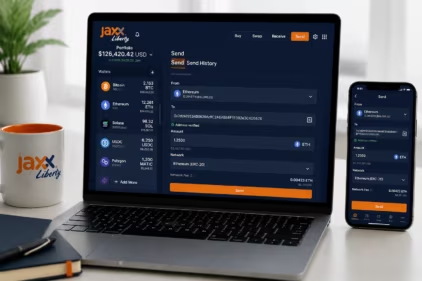
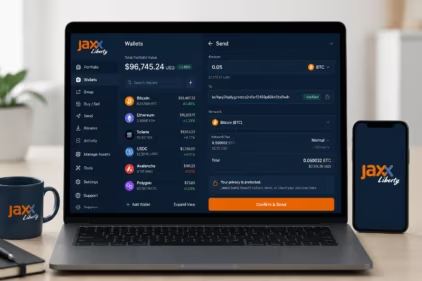
Let’s make it concrete. Marcus holds 0.15 ETH in Jaxx Liberty on his desktop. He wants real dollars in a real bank account. Here’s what he actually does: he opens a centralized exchange that supports fiat withdrawals in his region, copies his ETH deposit address from that platform, then flips over to Jaxx Liberty, navigates to his Ethereum wallet, and hits Send. He pastes the address — never types it, pastes it — double-checks every character, reviews the network fee the wallet surfaces before confirmation, and submits. Minutes later, the ETH lands on the exchange. He places a sell order, converts to USD at market rate, then initiates a bank withdrawal. One to two business days. Money in account. Done. For the full step-by-step breakdown, the Jaxx Liberty cash out guide covers every detail.
The same logic holds for Bitcoin, Litecoin, and every other supported asset. Jaxx Liberty carries BTC, ETH, LTC, and a wide roster beyond that — the send mechanics are identical across all of them. What shifts is the network and the corresponding deposit address on the exchange side. And this is where people lose money. Permanently. Sending Bitcoin to an Ethereum address, or selecting the wrong network standard, produces an irreversible loss — no appeals process, no support ticket that fixes it. Jaxx Liberty surfaces clear asset labels and network identifiers during the send flow precisely to cut this risk down. But the final check? That’s yours alone.
Three habits separate the people who do this cleanly from the ones who learn expensive lessons.
- Copy-paste every address, every time. One wrong character in a crypto address means the funds are gone. Not delayed — gone. Manual typing is a liability you don’t need.
- Read the fee before you confirm. Network fees shift with congestion, and they vary dramatically by asset. Jaxx Liberty shows the estimated fee before you commit — look at it, actually look at it, before tapping confirm.
- Run a small test transaction first. Moving a large amount for the first time? Send a tiny fraction, verify it arrives at the exchange, then move the rest. The cost of a test transaction is trivial. The cost of a misdirected bulk transfer is not.
Jaxx Liberty is non-custodial. Your private keys live locally on your device. There is no support team empowered to reverse a transaction or chase down misdirected funds. That’s the deal with self-custody — total control, total responsibility. The convert-crypto-to-cash workflow is straightforward, but it rewards precision. Build the habits once, and the whole process becomes second nature.
Cash-Out Route at a Glance
To successfully convert your digital assets into traditional currency, you must follow a structured path from your self-custody environment to a regulated exit point. This table outlines the critical stages of the cash-out process, highlighting how to maintain security and avoid common pitfalls when moving funds from your Jaxx Liberty Wallet.
| Stage | User Action | Why It Matters | Common Mistake | Smart Safety Habit |
|---|---|---|---|---|
| Wallet Preparation | Review balance and network fees | Ensures you have enough for gas/mining fees | Ignoring the «Send» fee requirements | Keep a small amount of native coin (e.g., ETH) for gas |
| Address Check | Verify exchange deposit address | Prevents permanent loss of funds | Using an old or incorrect network address | Always use «Copy/Paste» and verify the first/last 5 digits |
| Transfer to Exchange | Execute the «Send» transaction | Moves assets from self-custody to a trading platform | Sending via the wrong blockchain network | Perform a small «test» transfer before the full amount |
| Sale for Fiat | Sell crypto for USD/EUR/GBP | Locks in the value in traditional currency | Using «Market» orders during high volatility | Use «Limit» orders to control the exact sale price |
| Bank Withdrawal | Initiate transfer to bank account | Completes the exit to your usable bank balance | Withdrawing to an unsupported third-party account | Ensure the bank account name matches your exchange ID |
Step-by-Step: Transfer from Jaxx Liberty to an Exchange
To successfully convert your digital assets into traditional currency, you must first move them from your self-custody environment to a platform that supports fiat withdrawals. Follow these precise steps to ensure your assets are moved securely and efficiently.
- Select the specific asset you wish to move within your Jaxx Liberty Wallet interface. Whether you are holding Bitcoin, Ethereum, or another supported coin, ensure you have selected the correct wallet dashboard to view your balance and transaction history.
- Generate a deposit address on your chosen exchange. Log into the exchange where you intend to sell your crypto, navigate to the «Deposit» section, and select the matching cryptocurrency. Copy the provided deposit address exactly as it appears; never type it manually to avoid permanent loss of funds.
- Verify the network compatibility between Jaxx Liberty and the receiving platform. Ensure that both the wallet and the exchange are using the same blockchain network (e.g., ERC-20 for Ethereum-based tokens). Sending assets over an unsupported network will result in the total loss of your coins.
- Initiate a small test transaction if you are moving a significant amount of capital. By sending a minimal «dust» amount first, you can confirm that the address and network are correct before committing your full balance to the jaxx liberty transfer funds process.
- Enter the destination address and amount in the «Send» tab of your Jaxx Liberty Wallet. Paste the exchange address you copied earlier, double-check the first and last four characters, and set the amount you wish to transfer. Review the network fees, which are paid to miners to process your request on the blockchain.
- Confirm the transfer after a final review of all details. Once you authorize the transaction, Jaxx Liberty signs it with your local private keys and broadcasts it to the network. Because we are a non-custodial wallet, this action cannot be reversed or cancelled by our team.
- Monitor the blockchain for confirmation and wait for the exchange to credit your account. You can track the progress using the transaction ID (TXID) provided in your wallet. Once the required number of network confirmations is reached, the exchange will update your balance, allowing you to proceed with selling for fiat.
Where Users Get Stuck During a Jaxx Liberty Withdrawal
Most Jaxx Liberty withdrawals go sideways not because the process is hard, but because users blow past steps they’ve decided don’t matter — and then pay for it. Moving Bitcoin to an exchange or pushing Ethereum toward a trading platform before converting to fiat sounds routine. It isn’t. Small oversights at the transfer stage produce delayed transactions, vanished funds, and failed withdrawals with no one to call. Knowing where things break is how you stop them from breaking on your watch.
The single most lethal mistake in any Jaxx Liberty withdrawal is a wrong address. One bad character. That’s all it takes to fire your crypto into a wallet that will never belong to you — and in a non-custodial environment, there is no undo button, no support ticket that fixes it, no refund. Use the clipboard function every single time. Never type an address by hand. Then verify at least the first six and last six characters before you hit confirm. The second killer is the wrong network. Sending an ERC-20 token over BEP-20 doesn’t destroy your funds — it just makes them disappear into a chain the receiving platform isn’t watching. Crypto withdrawal safety lives or dies on one rule: the network selected in Jaxx Liberty must match the network the receiving wallet or exchange expects. Exactly. No exceptions.
Then there’s the impatience problem. Blockchain confirmations take time — Bitcoin can run anywhere from ten minutes to well over an hour depending on network congestion and whatever fee level you chose when you sent it. A pending transaction is almost never a failed one. It’s just waiting. Where users compound the damage is by setting fees so low the transaction gets deprioritized by miners, then panicking and assuming something broke. Nothing broke. It’s slow. Check the estimated fee and confirmation window before sending, not after. That one habit eliminates a shocking amount of unnecessary stress during a Jaxx Liberty withdrawal.
Finally — and this trips up more people than any technical glitch — sending crypto is not the same as withdrawing cash. These are two completely separate operations. Jaxx Liberty is a non-custodial wallet. It holds your assets. It does not cash you out. To convert holdings into real money, you transfer crypto from Jaxx Liberty to a supported exchange, sell the asset on that exchange, and only then initiate a fiat withdrawal to your bank or payment method. Three steps. In order. Users who skip building this mental model spend twenty minutes hunting for a «withdraw to bank» button inside Jaxx Liberty that was never there by design. Keep the stages distinct, apply the same crypto withdrawal safety discipline to each one, and the whole process stops being stressful — it just becomes a sequence you run.
A Simple Rule Experienced Users Follow
The one rule every battle-hardened crypto user lives by when cashing out: stop, breathe, and verify before you hit send. Each step in the pipeline — from pulling funds out of Jaxx Liberty to watching fiat land in your bank account — hides at least one point of failure. And almost every catastrophic loss traces back to the same root cause: someone moved too fast. Users who cross-check address details before confirming a transaction almost never lose funds to a misdirected send. Users who skip that step? Sometimes they lose everything. No recovery path. No second chances.
Before you initiate any outbound transfer from Jaxx Liberty, treat the destination address like it’s the only thing standing between you and a permanent loss — because it is. Copy it, paste it, then read the first four and last four characters against the original source. Every single time. No exceptions. Clipboard hijacking malware exists for exactly this scenario, silently swapping your copied address for an attacker-controlled one the moment it hits your clipboard. Blockchain transactions are irreversible. There is no support ticket, no escalation path, no miracle that fixes a send to the wrong address. A secure exchange transfer begins the instant you confirm that what you pasted is exactly what you intended to use.
Network selection is the second checkpoint — and it’s where careful users separate themselves from expensive cautionary tales. Sending an ERC-20 token over the wrong network, or pushing Bitcoin toward a Litecoin address, produces outcomes ranging from permanently vaporized funds to nightmarish manual recovery processes that most exchanges flatly refuse to touch. Verify the network on both ends: inside Jaxx Liberty and on the receiving exchange. Then pull up the fee estimate before you approve anything. Fees swing hard based on network congestion. A transaction submitted during a high-load window can cost dramatically more than you expected. Knowing the fee upfront isn’t optional — it’s part of executing a responsible cash-out.
The practical playbook is brutally simple. Build a personal checklist. Run it before every cash-out, even when the transaction feels routine — especially when it feels routine. Verify the address. Confirm the network. Review the fee. Then send. Experienced users aren’t faster than beginners. They’re more deliberate. That deliberateness is the entire edge. Jaxx Liberty is a non-custodial wallet with no centralized recovery system, which means the full weight of every transaction sits squarely on your shoulders. Full control was the design choice. Using that control carefully is what makes it work in your favor.
How to Sell Crypto for Fiat After the Transfer Arrives
The moment your crypto lands on the exchange, the clock starts — sell it right and real money hits your bank account faster than most people expect. The path from digital asset to spendable cash is shorter than it looks, but two or three small decisions along the way determine whether you walk away with the full amount or quietly hand a chunk of it to fees and bad timing.
Head straight to the trading or «sell» section. Pick the asset you just transferred — BTC, ETH, whatever you moved — then select the fiat pair that matches your currency: BTC/USD, ETH/EUR, take your pick. The exchange throws a live quoted price at you immediately. Here’s the thing most people skip: that quoted price is not what you actually receive. Trading fees run between 0.1% and 0.5% per transaction, and certain platforms quietly stack a spread on top of that. Enter your amount, stare hard at the estimated payout after fees, and only then hit confirm. If the quoted rate looks suspiciously low compared to any market tracker, wait three minutes. Rates stabilize. Patience here costs nothing.
Once the sell order fills, your fiat balance appears in the exchange account — clean USD, EUR, or whichever currency you chose. Now comes the final move: pulling those funds out to your actual bank. Navigate to the withdrawal section, select your verified bank account or payment method, punch in the amount. No shortcuts here — KYC verification must be fully approved before any fiat leaves the platform, so sort that paperwork before you even think about selling. Standard bank transfers clear in one to three business days. Debit card payouts and third-party processors move faster if your exchange supports them. For the full transfer and withdrawal walkthrough starting directly from Jaxx Liberty Wallet, the jaxx liberty withdrawal guide covers every step in sequence.
Four habits that protect you every single time:
- Verify the destination twice. A wrong bank account number or IBAN is gone. No reversal, no rescue, no exception.
- Separate the withdrawal fee from the trading fee. They are not the same line item. Flat bank transfer fees can run anywhere from $5 to $25 depending on the method — that’s real money quietly disappearing if you don’t check.
- Save every transaction ID and confirmation email. Support teams cannot help you without them, and you will eventually need support.
- Stay methodical. This process is routine when you treat it like a checklist, not an impulse.
Jaxx Liberty hands you full control over your assets right up to the second you fire off that first transfer. What happens after that is entirely up to how carefully you read the screen before clicking confirm.
Fees and Timing to Review Before You Cash Out
Before you initiate a transfer from your Jaxx Liberty Wallet to an exchange for cashing out, it is essential to understand the cumulative costs and the time required for each stage of the process. Managing these variables ensures you maintain control over your liquidity and avoid unexpected delays in receiving your fiat currency.
| Category | Estimated Cost / Time | What to Review Before Proceeding |
|---|---|---|
| Network Fee (Gas) | Variable (Blockchain-based) | Check current congestion levels in Jaxx Liberty to ensure your fee is sufficient for timely confirmation. |
| Exchange Trading Fee | 0.1% – 0.5% per trade | Verify the spot price and the exchange’s fee tier for your specific trading volume. |
| Fiat Withdrawal Fee | Fixed or % (e.g., $1 – $25) | Review the withdrawal method (SEPA, Wire, ACH) as fees vary significantly between providers. |
| Confirmation Wait | 10 – 60 Minutes | Confirm the number of network confirmations required by your chosen exchange before funds are credited. |
| Bank Processing Time | 1 – 3 Business Days | Account for weekends and bank holidays which can extend the time it takes for fiat to appear in your account. |
Need Wallet Access Before Cashing Out?
Before you can cash out your wallet balance, you must ensure your Jaxx Liberty interface is properly synced and your assets are ready for a secure crypto transfer. Establishing a stable connection is the first step to managing your private keys and preparing for a successful withdrawal to your chosen exchange.
How to Withdraw Fiat to Your Bank or Payment Method
Once you have successfully sold your cryptocurrency on your chosen exchange, the final phase is moving those funds into your personal bank account. This process ensures your digital gains are converted into usable fiat currency while maintaining the security standards we advocate at Jaxx Liberty.
- Select your fiat balance within the exchange’s wallet or dashboard section to view the available funds ready for withdrawal.
- Choose your preferred payment method, such as a direct bank transfer (ACH or SEPA), wire transfer, or a supported third-party payment processor.
- Confirm your account details by double-checking the IBAN, SWIFT code, or routing number to prevent any routing errors that could delay the transaction.
- Check the withdrawal fees associated with your chosen method, as these vary depending on the speed of the transfer and the exchange’s specific policy.
- Submit the withdrawal request and complete any required two-factor authentication (2FA) steps to authorize the movement of funds.
- Monitor the transaction status through the exchange’s history tab until the funds arrive in your bank account, typically taking between a few hours and several business days.

Security Habits That Make Cashing Out Safer
The security habits you build before hitting «send» in Jaxx Liberty are the only thing standing between your funds and a permanent, irreversible mistake. The single most common blunder? Rushing the address field. Users copy a wallet address once, glance at it, assume it transferred cleanly — and lose everything. Paste the destination address, then manually verify at least the first six and last six characters against the original source. Not four. Not a quick scroll. Six and six, every single time. One wrong character sends your funds to an address you will never control, and in a non-custodial environment, there is no phone number to call, no ticket to open, no recovery path. Treat every send as irreversible. Because it is.
Your network environment matters just as much as the address itself. Public Wi-Fi? Absolutely not. Shared hotspots, hotel lobbies, airport lounges — these are hunting grounds. Man-in-the-middle attacks and clipboard hijacking malware are not theoretical in 2026; they specifically target users mid-transaction, swapping your pasted address for one controlled by an attacker. Use a private, password-protected connection you personally control. If you regularly move larger amounts, a dedicated VPN layer is not paranoia — it is baseline hygiene. And before you hit confirm, actually look at the fee estimate Jaxx Liberty displays. Network fees spike without warning, especially on Ethereum-based assets, and confirming during a congestion peak can cost you significantly more than you planned. If the fee looks wrong, pause. Check current network conditions. The transaction will still be there in five minutes.
Confirmation delays are normal. They do not mean your transaction failed. Bitcoin and other proof-of-work networks can take anywhere from a few minutes to well over an hour depending on mempool congestion. Ethereum moves faster under calm conditions, but activity spikes slow everything down hard. Do not resend. Do not assume failure. Resending risks a double-spend attempt or duplicate fee loss — two outcomes that are worse than waiting. Open a block explorer, paste your transaction hash, and watch the status directly. Staying calm during this window is not optional; it is part of responsible self-custody. For a deeper look at how the wallet handles these full operational flows, the jaxx liberty wallet review covers the complete picture.
Jaxx Liberty was built around one principle: you are in full control. No support team can reverse your transaction. No centralized system holds a backup of your keys. No recovery option exists if you send to the wrong address. What actually protects you is process — and process takes thirty extra seconds. Copy carefully. Verify characters. Use a secure connection. Review fees. Wait out confirmations without panic. Thirty seconds per transaction eliminates the vast majority of withdrawal-related losses that self-custody users experience. That is the entire trade-off. Own it.
Conclusion
Cashing out of Jaxx Liberty comes down to three brutal steps: move your assets to a real exchange, sell them for actual money, and pull that money out — bank account, payment method, done. The framework holds whether you’re offloading Bitcoin, Ethereum, or anything else sitting in your self-custody wallet, and it gives you hard control at every single stage.
Address verification is not a suggestion. Jaxx Liberty keeps your private keys on your device — nobody else touches them, nobody else can recover them — which means a wrong address is a permanent goodbye to your funds. Copy-paste every address, every time. Then check the first four characters and the last four characters before you hit send. While you’re at it, look at the network fee. Gas on Ethereum can triple in twenty minutes. Bitcoin miner fees spike without warning. Pick the wrong fee tier and you’re either waiting hours or overpaying for no reason.
Security habits matter long after the transaction clears. Your seed phrase lives offline — written down, locked away, never typed into an exchange form or handed to a «support agent» who slid into your DMs. Use only exchanges with two-factor authentication enabled. Log out when you’re finished. Moving a large position? Split it across several transactions. One point of exposure is one point of failure, and in a self-custody setup there is no safety net underneath you.
Jaxx Liberty hands you genuine ownership of your assets. That ownership includes the exit. Follow the send-sell-withdraw sequence, stay sharp on addresses and fees, and treat security as a hard requirement rather than a checklist item — and you move from crypto to cash without drama, without loss, and without handing control to anyone else.
Import your old wallet
Ready to withdraw money from crypto? Import your existing seed phrase into Jaxx Liberty to manage your assets, verify network fees, and securely transfer funds to your preferred exchange for a successful cash-out.
Часто задаваемые вопросы
Can I cash out directly from Jaxx Liberty to my bank account?
No. Jaxx Liberty is a non-custodial wallet with no built-in fiat conversion or bank withdrawal feature. To cash out, you must transfer your crypto to a supported exchange, sell it there for fiat, and then initiate a bank withdrawal from that exchange.
How do I avoid sending crypto to the wrong address when withdrawing from Jaxx Liberty?
Always copy and paste the destination address — never type it manually. After pasting, verify at least the first six and last six characters against the original source before confirming. Be aware that clipboard hijacking malware can silently swap your copied address, so double-checking is essential every single time.
How long does it take to cash out from Jaxx Liberty to a bank account?
The full process typically takes one to three business days. Blockchain confirmation alone can take 10 to 60 minutes depending on network congestion and the fee level you selected, followed by the exchange crediting your account and then a standard bank processing window of one to three business days.
What fees should I expect when cashing out from Jaxx Liberty?
There are three separate fee layers: a variable network fee paid to blockchain miners when you send from Jaxx Liberty, an exchange trading fee of roughly 0.1% to 0.5% when you sell your crypto for fiat, and a fiat withdrawal fee ranging from approximately $1 to $25 depending on the method such as ACH, wire, or SEPA.
What happens if I send crypto over the wrong network from Jaxx Liberty?
Sending assets over an incompatible network — for example, an ERC-20 token sent via BEP-20 — can result in funds that are inaccessible or permanently lost, as most exchanges will not support manual recovery. Always confirm that the network selected inside Jaxx Liberty exactly matches the network the receiving exchange expects before submitting any transaction.